
This article briefly describes the structural functions of homopolysaccharides. Homopolysaccharides are complex carbohydrates composed of numerous repeating units of a single type of monosaccharide, linked together through glycosidic bonds. Beyond their role as energy reserves, certain homopolysaccharides serve essential structural functions in living organisms by providing mechanical strength, rigidity, stability, and protection to various biological structures. Their structural properties are closely associated with the nature of their constituent monosaccharides, the configuration of glycosidic linkages, and the resulting three-dimensional molecular conformations. Differences in these molecular arrangements influence chain flexibility, intermolecular interactions, solubility, and resistance to degradation. Cellulose and chitin are prominent examples of structural homopolysaccharides, contributing to the strength of plant cell walls and the protective exoskeletons of arthropods, respectively.
Cellulose is a Major Structural Homopolysaccharide in Plants
The most abundant structural homopolysaccharide in nature, cellulose serves as a major component of plant cell walls. It is a tough, fibrous, and water-insoluble polysaccharide that is particularly abundant in the stalks, stems, trunks, and woody tissues of plants. It contributes substantially to the structural framework of plants, providing rigidity, strength, and mechanical support. Cotton consists almost entirely of cellulose, while it also accounts for a considerable proportion of wood.
Structurally, cellulose is a linear, unbranched homopolysaccharide composed of approximately 10,000–15,000 D-glucose residues linked through β(1→4) glycosidic bonds. Unlike amylose, which contains α-D-glucose units joined by α(1→4) linkages, cellulose possesses β-configured glucose residues. This difference in the configuration of glucose units profoundly influences the three-dimensional arrangement of the polysaccharide chains. The extended chains of cellulose associate with neighbouring chains through extensive hydrogen bonding, forming strong, insoluble fibres that contribute to the remarkable tensile strength and structural stability of plant cell walls.
Owing to these distinctive physical and structural properties, cellulose has considerable industrial significance. It is widely utilised in the manufacture of paper, cardboard, insulation materials and textile fibres such as cotton and linen. Furthermore, cellulose serves as an important raw material for producing regenerated cellulose products, including cellophane, rayon and lyocell.
Cellulose Digestion and Enzymatic Limitations
Enzymes such as α-amylases and glycosidases, present in saliva and the small intestine, break down dietary starch and glycogen during digestion. These enzymes facilitate the hydrolysis of α(1→4) glycosidic bonds, releasing smaller carbohydrate molecules. In contrast, most vertebrates are unable to utilise cellulose as an energy source because they lack the enzyme cellulase required to break its β(1→4) glycosidic linkages. However, termites can digest cellulose with the assistance of symbiotic microorganisms residing in their intestinal tract. One such microorganism, Trichonympha, produces cellulase, an enzyme that breaks down cellulose by hydrolysing its β(1→4) linkages.
Microbial Adaptations for Cellulose Digestion in Animals
Molecular genetic investigations have demonstrated that numerous invertebrates, including arthropods and nematodes, possess genes responsible for producing enzymes involved in cellulose degradation. Among vertebrates, ruminants such as cattle, sheep and goats represent a notable exception to the general inability to digest cellulose independently. Their rumen contains specialised symbiotic microorganisms that produce cellulolytic enzymes, enabling the breakdown of cellulose present in their plant-based diet, particularly soft grasses rather than highly lignified woody materials. During microbial fermentation, symbiotic microorganisms break down cellulose and produce short-chain fatty acids, mainly acetate, propionate, and butyrate, which provide energy to the animal and support various metabolic processes, including milk production.
Cellulose Degradation in Bioenergy Production and Biomass Conversion
Plant biomass rich in cellulose represents a valuable renewable resource for producing biofuels, particularly ethanol, through enzymatic hydrolysis followed by microbial fermentation. The resulting bioethanol can be blended with gasoline and utilised as an alternative transportation fuel. Given the enormous quantities of photosynthetic biomass generated annually across the Earth, cellulose has considerable potential as a sustainable feedstock for bioenergy production. Consequently, cellulolytic enzymes, particularly cellulases, have attracted considerable research interest for improving the efficiency of biomass conversion. An important example of an efficient cellulose-degrading system is the cellulosome, a specialised extracellular multiprotein complex found in certain bacteria, including Clostridium cellulolyticum. These complexes contain cellulase enzymes associated with structural proteins that anchor the catalytic components to the bacterial cell surface and facilitate the binding and positioning of cellulose for enzymatic degradation.
However, the conversion of plant biomass into biofuels presents several challenges, particularly because a substantial proportion of terrestrial photosynthetic biomass consists of woody plant materials. In addition to cellulose, wood contains other complex carbohydrate-derived polymers that resist biological and chemical degradation. Among these, lignin is a major constituent, accounting for approximately 20–30% of wood mass. It is a complex aromatic polymer synthesised from phenylalanine-derived precursors and is extensively associated with cellulose and other cell-wall components. Its complex structure and interactions with cellulose restrict the accessibility of cellulases to their substrates, thereby making the enzymatic breakdown of lignocellulosic biomass more difficult.
Chitin as a Major Structural Polysaccharide
A linear, unbranched homopolysaccharide, chitin consists of repeating units of N-acetyl-D-glucosamine joined together through β(1→4) glycosidic linkages. Its molecular structure closely resembles that of cellulose, with the primary distinction being the substitution of the hydroxyl group at the C-2 position of glucose with an N-acetylamino group. Similar to cellulose, chitin chains adopt extended conformations and associate to form strong, fibrous structures. It is resistant to digestion by most vertebrates due to their inability to produce the enzymes required for its efficient degradation. Chitin serves as the principal structural material of the exoskeletons of numerous arthropods, including insects, lobsters and crabs, providing mechanical strength, rigidity and protection. It is considered the second most abundant polysaccharide in nature after cellulose, with an estimated annual biosynthetic production of approximately one billion tonnes worldwide.
Structural Comparison Between Cellulose and Chitin
Cellulose and chitin exhibit remarkable similarities in their molecular organisation, as both are linear, unbranched homopolysaccharides containing β(1→4) glycosidic linkages. However, they differ in their constituent monosaccharides: cellulose is composed of D-glucose residues, whereas chitin consists of N-acetyl-D-glucosamine units. Despite this chemical distinction, both polysaccharides form extended chains that associate through intermolecular hydrogen bonding, resulting in strong, fibrous structures. While cellulose provides mechanical strength and rigidity to plant cell walls, chitin performs a comparable structural function in the exoskeletons of arthropods.
Molecular Conformation and Factors Governing Polysaccharide Structure
The three-dimensional organisation of polysaccharides follows principles similar to those governing protein structure. Their constituent monosaccharide units adopt relatively rigid conformations maintained by covalent bonds. However, the overall molecular architecture is influenced by weaker non-covalent interactions occurring within individual chains and between neighbouring molecules. These interactions include hydrogen bonding, van der Waals forces, and hydrophobic interactions. Electrostatic interactions may also contribute to structural organisation in polysaccharides containing charged groups. Among these forces, hydrogen bonding plays a particularly significant role because of the abundance of hydroxyl groups present in carbohydrate molecules. Collectively, these interactions influence molecular folding, chain association and the stability of polysaccharide assemblies.
Most naturally occurring polysaccharides, including starch, glycogen and cellulose, contain monosaccharide units in the pyranose form, characterised by a six-membered ring structure. Glycosidic linkages connect these relatively rigid rings and allow them to rotate to some extent around the bonds joining adjacent sugar residues. However, steric interactions between neighbouring atoms and substituent groups restrict this rotational flexibility. Consequently, the spatial arrangement of polysaccharide chains depends on the rotational orientations of their glycosidic linkages, commonly described using the dihedral angles φ (phi) and ψ (psi) (Figure 1). These angles determine the relative positioning of successive monosaccharide residues and contribute significantly to the overall three-dimensional conformation of the polymer.
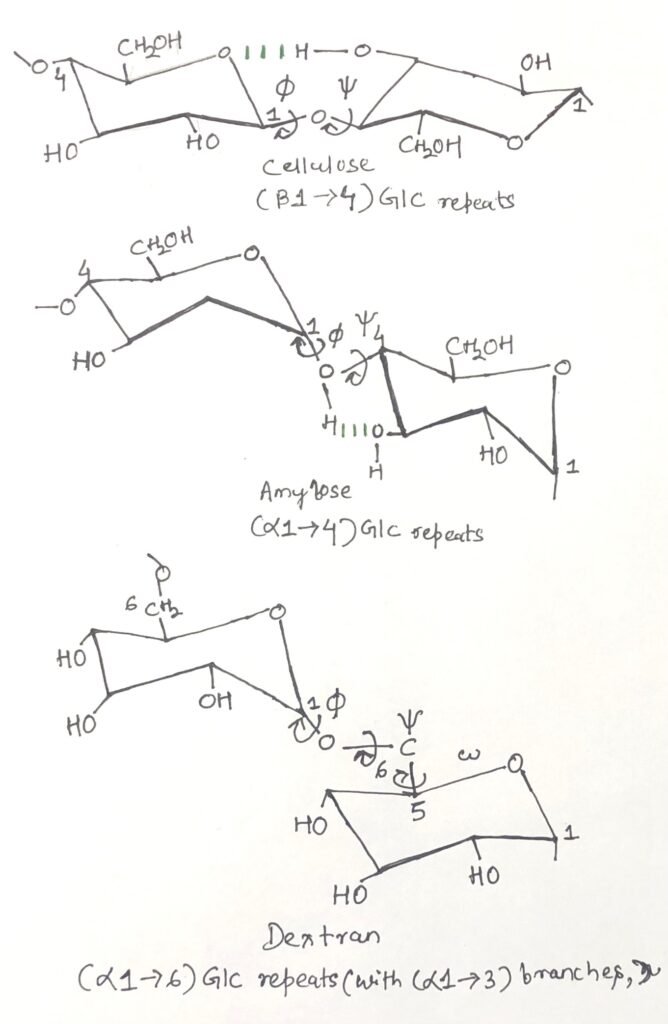
The spatial dimensions of pyranose rings, the orientation of their substituent groups, and electronic effects associated with the anomeric carbon further influence the conformational preferences of polysaccharides. These factors restrict the range of possible rotational arrangements around glycosidic bonds, favouring certain conformations over others. As a result, different types of glycosidic linkages produce distinct molecular architectures, which ultimately influence the physical and biological properties of polysaccharides.
Helical Organisation of Starch and Glycogen
The α(1→4)-linked glucose chains present in amylose, a major component of starch, preferentially adopt a helical conformation (Figure 2). The stereochemical configuration of glycosidic linkages, along with favourable molecular interactions such as hydrogen bonding and van der Waals forces, promotes this arrangement. The regular helical organisation of amylose also facilitates the formation of ordered crystalline regions, which researchers can examine using X-ray diffraction techniques. A typical amylose helix contains approximately six glucose residues per complete turn, with successive glucose rings adopting a characteristic spatial orientation.
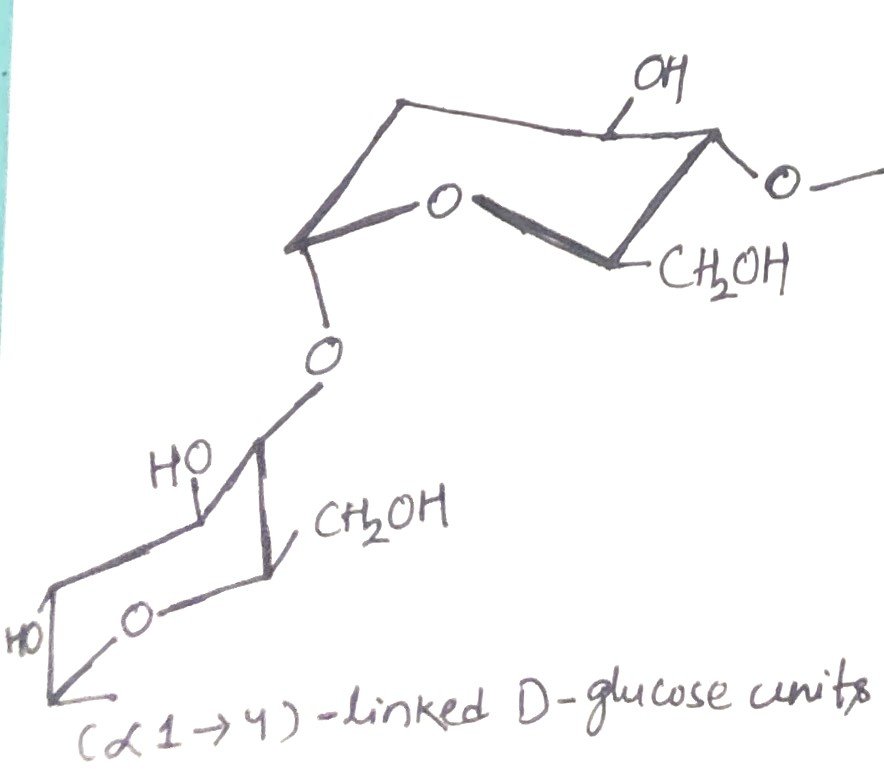
An important feature of the amylose helix is its central cavity, which can accommodate iodine species to form a characteristic deep-blue complex. This molecular interaction provides the basis for the iodine test, commonly employed for the qualitative detection of starch, particularly its amylose component. Glycogen also contains α(1→4)-linked glucose chains, but its extensive α(1→6) branching produces a more compact and highly branched molecular architecture rather than the predominantly linear organisation observed in amylose.
Extended Chain Conformation and Fibre Formation in Cellulose
Unlike amylose, cellulose adopts an extended and relatively straight molecular conformation because of the stereochemical arrangement of its β(1→4) glycosidic linkages. Each glucose residue rotates approximately 180° relative to the preceding residue, thereby arranging the glucose rings alternately along the cellulose chain. This configuration allows the cellulose molecules to extend into long, unbranched chains rather than forming helical structures. The numerous hydroxyl groups present along these chains facilitate extensive hydrogen bonding, both within individual molecules and between adjacent cellulose chains. When several chains align parallel to one another, these interactions promote the formation of highly organised supramolecular structures known as cellulose microfibrils. Such assemblies exhibit remarkable tensile strength, rigidity and resistance to deformation, making cellulose an effective structural material in plant cell walls.
The extensive hydrogen-bonding network also contributes to the limited water solubility of cellulose by stabilising interactions between neighbouring chains and restricting their separation by water molecules. These distinctive structural properties have made cellulose an important raw material for numerous applications over centuries. Industries widely use cellulose to manufacture paper, cardboard, textiles, rayon, cellophane, and various insulation materials.
Conclusion
Homopolysaccharides play essential structural roles in biological systems by providing mechanical strength, rigidity, and protection. Their structural properties depend on monosaccharide composition, glycosidic linkages, and three-dimensional molecular arrangements. Cellulose and chitin are prominent examples, strengthening plant cell walls and arthropod exoskeletons, respectively. Hydrogen bonding and other intermolecular interactions further stabilise their molecular structures. Differences in glycosidic linkages also account for the distinct conformations and properties of starch, glycogen and cellulose. Thus, the molecular architecture of homopolysaccharides determines their physicochemical properties and biological functions, while also contributing to their industrial significance.
You may also like:

I, Swagatika Sahu (author of this website), have done my master’s in Biotechnology. I have around fourteen years of experience in writing and believe that writing is a great way to share knowledge. I hope the articles on the website will help users in enhancing their intellect in Biotechnology.