
This article briefly describes homopolysaccharides, their structural characteristics and their diverse biological functions. Starch and glycogen are important glucose-storage polymers in plants and animals, respectively, exhibiting distinct molecular arrangements and branching patterns. Their structural organization facilitates the storage and efficient mobilization of glucose to meet cellular energy requirements. Dextrans, another group of glucose-based homopolysaccharides, possess characteristic glycosidic linkages and branching patterns that contribute to their distinctive properties. They are particularly significant in bacterial adhesion and dental plaque formation, as well as in biotechnological applications such as protein separation through size-exclusion chromatography. Together, these polysaccharides demonstrate how variations in carbohydrate structure contribute to their diverse biological and industrial significance.
Polysaccharides as Energy Reserves
Carbohydrates predominantly occur in nature in the form of complex polysaccharides, which consist of long chains of monosaccharide residues and possess varying molecular sizes. These macromolecules, commonly referred to as glycans, exhibit considerable structural diversity depending on the nature of their constituent sugar units, polymer chain length, glycosidic linkage patterns, and extent of branching. Based on their monomeric composition, homopolysaccharides are characterized by the presence of a single type of monosaccharide repeated throughout the polymeric structure. Several members of this group function as energy reserves by storing monosaccharide units that can subsequently be mobilized for metabolic energy production. Starch and glycogen are prominent examples of such storage polysaccharides.
Structure and Composition of Starch
Starch is composed of two distinct glucose-based polymers, namely amylose and amylopectin, which differ in their molecular architecture. Amylose is predominantly linear, consisting of extended chains of D-glucose units joined through α(1→4) glycosidic bonds (Figure 1).

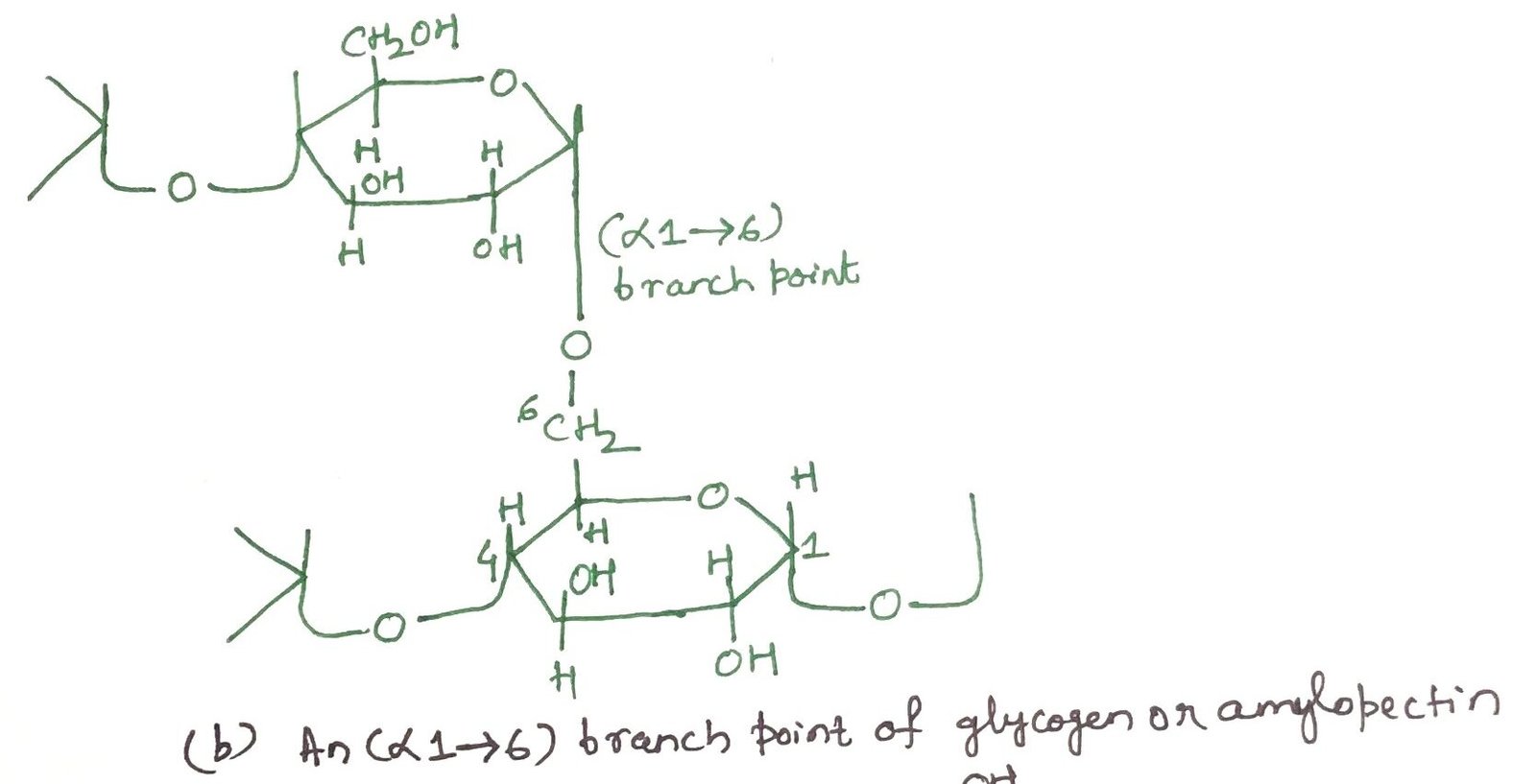
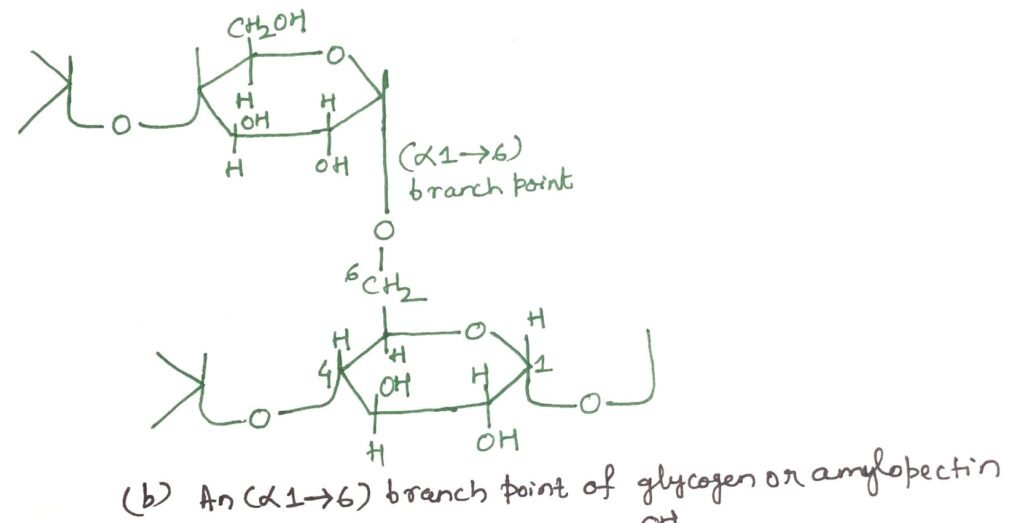
Its polymer chains exhibit considerable variation in molecular size, ranging from a few thousand to over a million molecular mass units. In contrast, amylopectin possesses a highly branched configuration despite its similarly large molecular size. The glucose residues within its main chains are connected by α(1→4) glycosidic linkages, whereas α(1→6) linkages create branching points at intervals of approximately 24–30 glucose residues (Figure 1b).
Structure and Mobilization of Glycogen
Glycogen serves as the principal carbohydrate reserve in animal tissues. Structurally, it resembles amylopectin, as its glucose residues are interconnected through α(1→4) glycosidic bonds, while α(1→6) linkages form branch points. However, glycogen exhibits a greater degree of branching and a more compact molecular arrangement than starch. It is particularly concentrated in the liver, where it can account for approximately 7% of the tissue’s wet weight, and is also stored in skeletal muscles.
Within liver cells (hepatocytes), glycogen occurs as large cytoplasmic granules formed by the aggregation of smaller particles. Each smaller particle contains an individual, extensively branched glycogen molecule with a molecular mass of several million daltons. These larger granules also incorporate enzymes involved in glycogen formation and breakdown, facilitating the regulation of its metabolism.
The highly branched architecture of glycogen provides numerous non-reducing terminal ends while retaining a single reducing end per molecule. During glycogen degradation, glucose residues are sequentially released from these non-reducing termini. Since the degradative enzymes act at these terminal regions, several branches can undergo breakdown simultaneously. This structural arrangement enables rapid mobilization of stored glucose to meet the energy requirements of animal.
Advantages of glycogen storage
The storage of glucose in the form of glycogen offers important osmotic and metabolic advantages to animal cells. Since glycogen is largely insoluble and contributes minimally to the osmotic pressure of the cytoplasm, its accumulation does not significantly disturb cellular osmotic balance. In contrast, storing equivalent quantities of glucose in its free form would considerably increase intracellular osmolarity, potentially causing excessive water influx and cellular damage. Furthermore, maintaining glucose as a polymer prevents the need for excessively high intracellular free-glucose concentrations. Thus, avoiding an unfavourable concentration gradient that would otherwise make glucose uptake energetically demanding.
Dextran
Dextrans are microbial polysaccharides synthesized by certain bacterial and yeast species, consisting primarily of D-glucose units arranged through α(1→6) glycosidic linkages. Their molecular architecture includes branching predominantly through α(1→3) bonds, although α(1→2) and α(1→4) linkages may also occur in certain forms. These polymers contribute significantly to the development of dental plaque. Their adhesive characteristics promote the attachment of microorganisms to tooth surfaces facilitating bacterial aggregation. Furthermore, dextrans can act as a carbohydrate reserve, supplying glucose for microbial metabolic activities.
In addition to their biological functions, dextrans have considerable industrial and biotechnological importance. Chemically modified dextrans are used to produce insoluble, porous matrices with varying pore dimensions. These materials are commercially utilized in size-exclusion chromatography. This is particularly for separating and fractionating proteins based on differences in their molecular sizes.
Conclusion
Homopolysaccharides exhibit considerable structural diversity despite being composed of a single type of monosaccharide. Their variations in glycosidic linkages, chain length and branching patterns determine their distinct physicochemical properties and biological functions. Starch and glycogen serve as important energy reserves in plants and animals, respectively, providing readily mobilizable glucose when required. In contrast, dextrans demonstrate the broader functional significance of these polymers through their involvement in microbial adhesion and their applications in biotechnological processes. Thus, homopolysaccharides play diverse roles in biological systems while also offering valuable applications in scientific and industrial fields.
You may also like:
- The metabolism of fuel in fasting and starvation
- Maintenance of Blood Glucose Level by the Hormones Insulin and Glucagon

I, Swagatika Sahu (author of this website), have done my master’s in Biotechnology. I have around fourteen years of experience in writing and believe that writing is a great way to share knowledge. I hope the articles on the website will help users in enhancing their intellect in Biotechnology.