
This article briefly describes how hormones were detected, isolated, purified, and chemically characterized, with the discovery of insulin providing an important example. Hormones are powerful chemical messengers that coordinate a wide range of physiological processes in the body. Their presence and activity can be identified through the biological effects they produce in specific tissues. It also highlights major advances such as the purification of thyrotropin-releasing hormone and the development of sensitive immunoassays such as RIA and ELISA.
Hormones as Chemical Signaling Molecules
Hormones are chemically diverse signaling molecules, including proteins and small organic compounds, that are synthesized by specific tissues and transported to distant target cells, often through the bloodstream. Their effects are mediated by highly specific cellular receptors, which initiate changes in cellular functions and metabolic activities. Through this signaling system, hormones coordinate the activities of multiple tissues and organs and contribute to the regulation of numerous physiological processes. These include the control of blood pressure, blood volume, and electrolyte balance, embryonic development, sexual differentiation, growth, reproduction, appetite, digestion, and the distribution and utilization of metabolic fuels. Understanding these diverse biological effects has also been fundamental to the detection, isolation, and purification of hormones.
Neuroendocrine Coordination and Chemical Signaling
In mammals, the neuroendocrine system coordinates metabolic activities, with cells communicating through chemical messengers. A change in the internal or external conditions of the organism can be detected by cells in one tissue. It prompts them to release signaling molecules. These molecules then reach other cells, bind to specific receptors, and induce appropriate changes in the activities of the target cells.
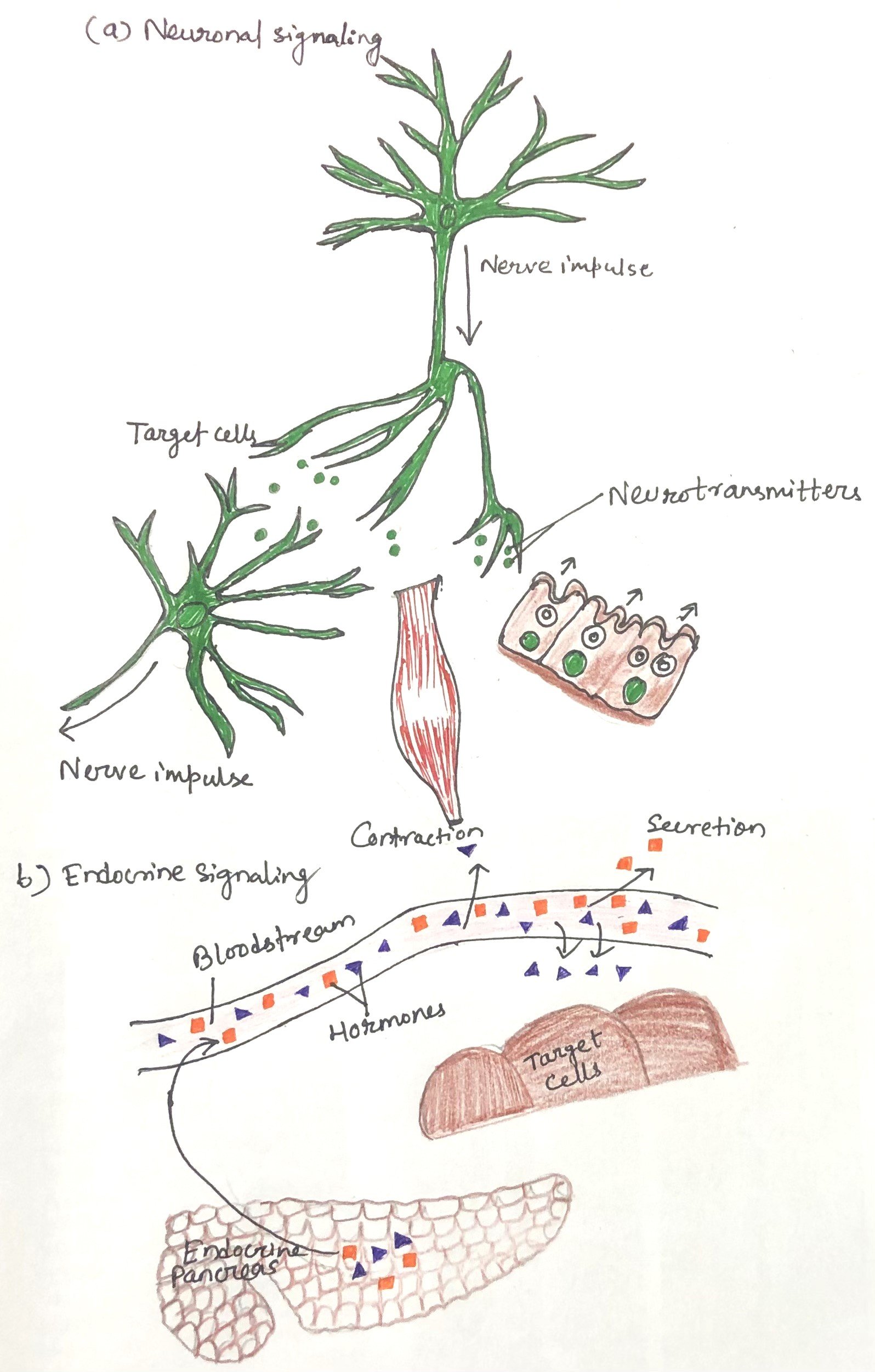
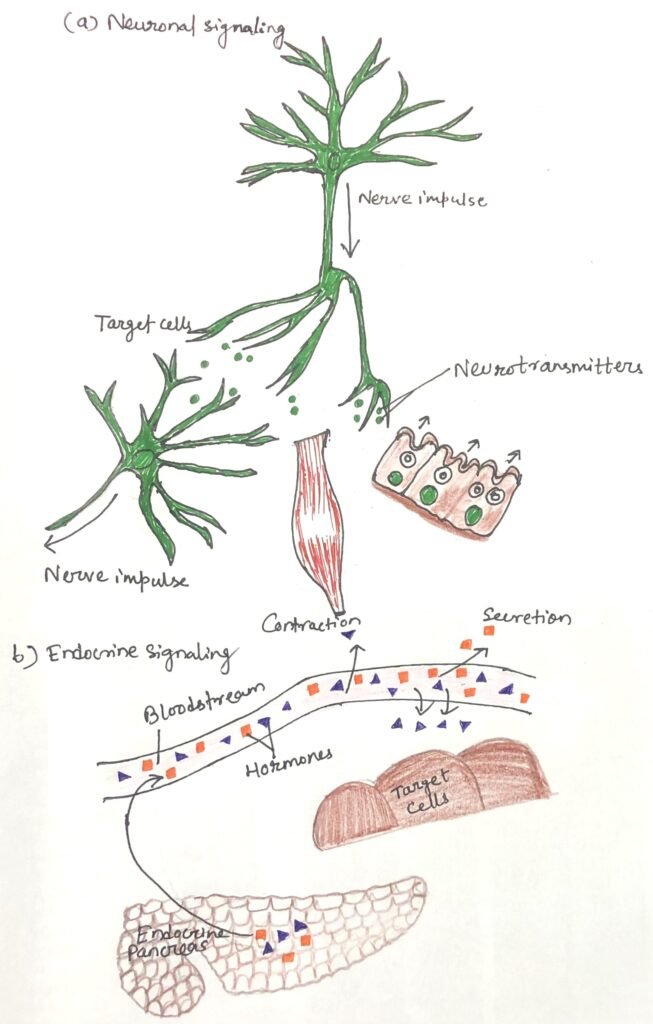
Chemical signals can act over widely different distances. In neuronal communication, neurotransmitters are released at synapses. They cross the small gap between adjacent cells to transmit signals (Figure 1a). In contrast, hormonal signaling involves the release of hormones into the bloodstream. They can then reach target cells in nearby tissues or distant organs (Figure 1b).
Despite this difference in the distance over which they act, neuronal and hormonal signaling share several fundamental features. Both depend on chemical messengers and specific receptors to alter the functions of target cells. Moreover, some signaling molecules can serve different roles depending on their site of action. They function as neurotransmitters in certain neural pathways and as hormones in the regulation of metabolic processes in tissues such as the liver and muscle.
Detection and Isolation of Hormones
A hormonal signal can be identified by showing that a physiological change in one tissue is influenced by a substance produced by another tissue. The early study of insulin provides a clear example of this approach. Insulin was first recognized as a substance produced by the pancreas that regulates glucose levels in the blood and urine. Its activity was tested by administering pancreatic extracts to experimental animals deficient in insulin. Researchers then measured the resulting changes in glucose levels. Once hormonal activity was confirmed, the active substance could be separated from the extract using biochemical techniques such as solvent fractionation, chromatography, and electrophoresis. Each fraction was tested for hormonal activity, allowing the active component to be progressively concentrated and purified. Following purification, its chemical composition and molecular structure could be investigated.
Challenges in Hormone Purification
Although this general strategy appears straightforward, the purification of hormones can be extremely challenging. This is because many hormones exert powerful biological effects even when present in minute quantities. Consequently, obtaining enough material for chemical characterization may require processing exceptionally large amounts of biological tissue. A notable example is the independent purification and characterization of thyrotropin-releasing hormone (TRH) by Andrew Schally and Roger Guillemin.
Their investigations required the processing of enormous quantities of hypothalamic tissue obtained from millions of animals. TRH was eventually identified as a small peptide derived from the amino acids glutamate, histidine, and proline. Once its structure had been established, the hormone could be synthesized chemically in larger quantities for further physiological and biochemical studies. Their work, together with Rosalyn Yalow’s development of the highly sensitive radioimmunoassay (RIA), marked a major advance in hormone research. RIA enabled hormones to be detected and quantified with remarkable sensitivity, even when they were present in extremely small amounts.
The high sensitivity of RIA depends on antibodies that recognize specific hormones with high affinity and specificity. These antibodies are produced by exposing suitable animals to purified hormones. This stimulates an immune response against the hormone. The antibodies can then be isolated and linked to a radioactive label for RIA. For ELISA, they are linked to an enzyme that produces a measurable colored product. When the labeled antibodies interact with a sample containing the target hormone, the hormone–antibody binding can be measured by detecting radiation or by photometry. Their strong and selective binding enables RIA and ELISA to detect and quantify hormones at extremely low concentrations, even at the picogram level.
Conclusion
The study of hormones has progressed from recognizing their biological effects to developing precise methods for their detection, isolation, purification, and characterization. Early investigations, such as those involving insulin, demonstrated how biological assays could reveal the presence of an active hormonal substance. Subsequent advances in biochemical purification and structural analysis enabled the identification of hormones at the molecular level. Techniques such as RIA and ELISA further improved the sensitivity and specificity of hormone measurement. These advances transformed hormone research. They also made it possible to detect these powerful signaling molecules at extremely low concentrations.
You may also like:
- Eicosanoids and Steroid Hormones Carry Messages to Cells and Tissues
- The Antigen-Antibody Interaction- Radioimmunoassay

I, Swagatika Sahu (author of this website), have done my master’s in Biotechnology. I have around fourteen years of experience in writing and believe that writing is a great way to share knowledge. I hope the articles on the website will help users in enhancing their intellect in Biotechnology.