
In this article, I briefly describe protozoa and their ecological significance. Protozoa are microscopic yet remarkably diverse organisms that occupy nearly every habitat on Earth. Despite their small size, they play a profound role in maintaining ecological balance and influencing both environmental processes and human health.
The Widespread World of Protozoa
Protozoa inhabit nearly all moist environments, from oceans and freshwater bodies to soils. Some protozoa even thrive in extreme habitats like polar regions and high altitudes. Free-living protozoa can spread widely due to their ability to survive harsh conditions, often by forming resistant cysts. For example, the soil amoeba Naegleria exists as a resistant cyst during dry periods, becomes a free-living amoeba in moist soil, and transforms into a flagellated form when flooded with water. Parasitic protozoa also adapt to changes in their hosts, modifying their form and function as needed. The malarial parasite Plasmodium, for instance, produces male gametes when it moves from a warm-blooded host to a cooler mosquito environment. These adaptations, along with the widespread presence of active forms in water and cyst forms in the atmosphere, have allowed protozoa to disperse globally and occupy diverse ecological niches.
Environmental Determinants of Protozoan Distribution
From an ecological perspective, protozoa can be classified into two main groups: free-living species and those that reside on or within other organisms. The latter are known as symbiotic protozoa. Among these, some are parasitic and may lead to diseases, while others provide benefits to their hosts, for example, the protozoa inhabiting the termite’s gut assist in digestion and nutrient absorption.
Free Living Protozoa
Free-living protozoa inhabit an extensive range of environments. Their distribution and population density within any habitat are shaped by several factors, including moisture levels, temperature, light availability, nutrient supply, and various physical and chemical conditions. The active, feeding stages of these organisms are present in diverse settings such as marine and freshwater systems, sandy regions, soils, and decomposing organic material.
Light and Protozoan Distribution
Protozoa that possess chromatophores and are capable of photosynthesis depend directly on sunlight for energy production. Consequently, species that feed on photosynthetic microorganisms also rely on light, although their dependence is indirect through the food chain. In contrast, certain protozoa exhibit negative responses to light and actively avoid illuminated environments. These species are better adapted to dark habitats, where they grow and reproduce successfully in the absence of sunlight.
Hydrogen Ion Concentration
Some protozoa can tolerate a wide range of pH, for example, pH 3.2 to 8.7. However, for the majority, a pH range of 6.0 to 8.0 is optimal for maximum metabolic activity.
Nutrient Availability and Protozoan Distribution
The composition of water plays a crucial role in shaping protozoan communities in aquatic ecosystems. Different species exhibit varying chemical preferences. Some flourish in oxygen-rich waters with minimal organic content, such as mountain springs, streams, and clear ponds, while others are better adapted to mineral-rich environments. Certain protozoa prosper where active oxidation and breakdown of organic material occur, whereas others are suited to habitats characterized by low oxygen levels but abundant decomposition products. A number of species are versatile enough to inhabit both marine and freshwater environments.
Availability of nutrients is another key factor regulating both the presence and population density of protozoa. For instance, Paramecium and other holozoic protozoa depend on a steady supply of bacteria or smaller protozoans for nourishment. Generally, species with broad feeding habits tend to have a wider geographic distribution, whereas those with specialized dietary requirements are more restricted in their range.
Temperature Tolerance and Protozoan Survival
Most protozoa exhibit optimal growth within a moderate temperature range of approximately 16–25 °C, while their upper thermal limit generally falls between 36–40 °C. Lower temperatures are usually less harmful than extreme heat, and tolerance levels may vary depending on the surrounding environmental conditions. Remarkably, protozoa have also been documented in hot spring waters reaching temperatures as high as 30–56 °C. At the opposite extreme, the phenomenon known as “red snow” in high-altitude regions results from hematochrome-containing flagellates that thrive in cold environments. Furthermore, protozoa in their encysted (dormant) stage can endure much wider temperature fluctuations compared to their active, feeding (trophic) forms.
Forms of Symbiotic Relationships in Protozoa
The relationships between protozoa and their hosts or associated organisms display considerable diversity. The broad term symbiosis refers to any form of close and prolonged association between different species, regardless of whether the interaction is beneficial, neutral, or harmful.
One type of symbiotic interaction is commensalism, in which the protozoan benefits while the host experiences neither harm nor advantage. This association may occur externally, known as ectocommensalism, where protozoa attach themselves to the surface of the host’s body. It may also occur internally, termed endocommensalism, when protozoa inhabit internal spaces such as the lumen of the alimentary canal.
Another significant relationship is mutualism, where both the protozoan and the host derive benefit. A classic example is the presence of specific flagellates in the digestive tract of termites. These microorganisms break down cellulose from ingested wood into usable glycogenous substances, enabling the termite to obtain nourishment. The relationship is obligatory: termites cannot survive without these flagellates, and the flagellates likewise depend on the termite gut for survival.
In contrast, parasitism involves a relationship in which the protozoan (the parasite) derives nourishment at the expense of its host. Parasites may consume host cells or cellular debris through structures such as pseudopodia or a cytostome, or they may invade host tissues and live within the cytoplasm or even the nuclei of cells. Such an invasion often results in pathological effects in the host. Members of the group Sporozoa are exclusively parasitic and include many protozoa responsible for serious diseases.
A more specialized form of parasitism is hyperparasitism, in which a parasitic protozoan becomes the host for another parasite, typically another protozoan or a metazoan parasite.
Functional Importance of Protozoa
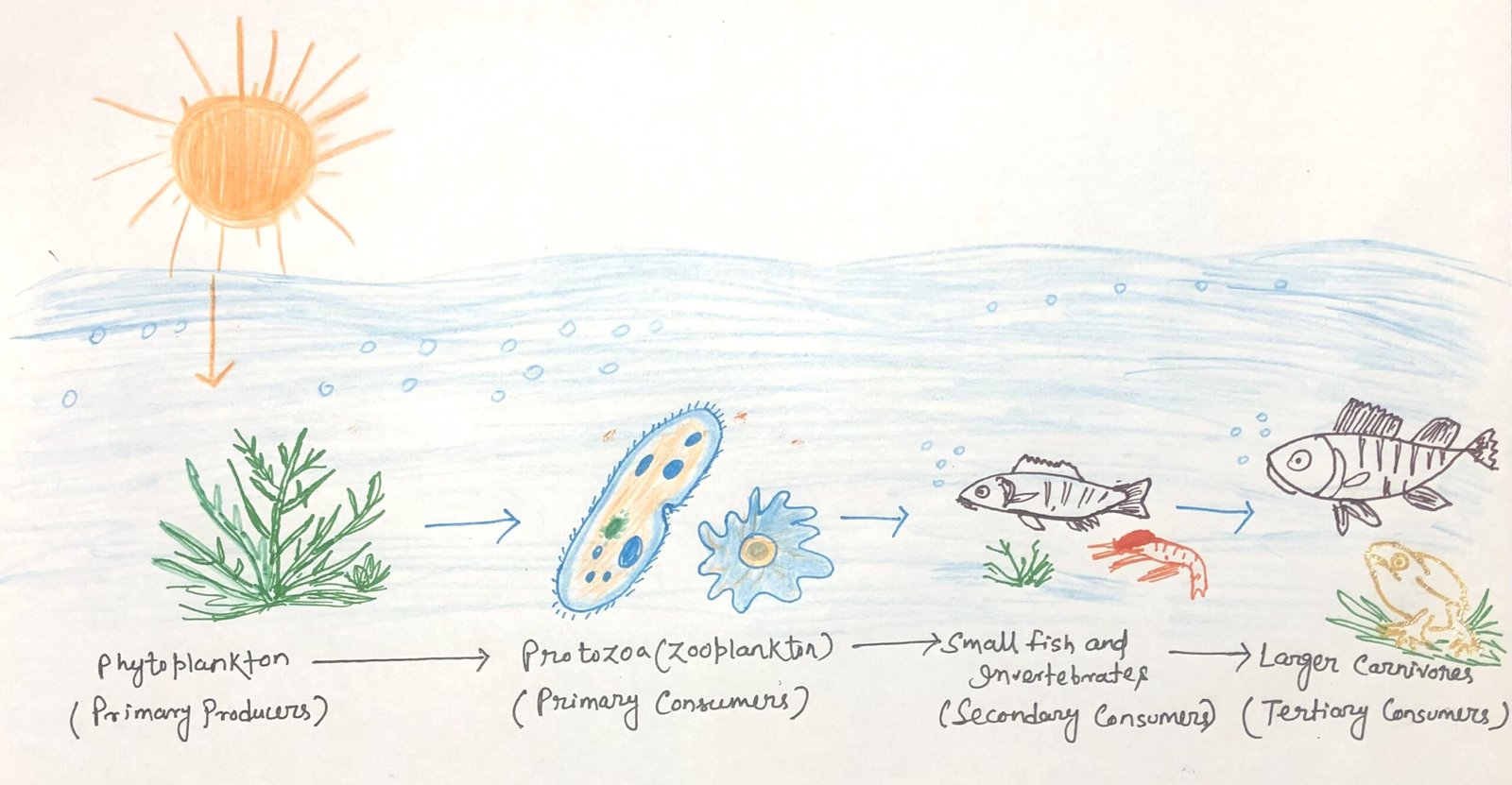
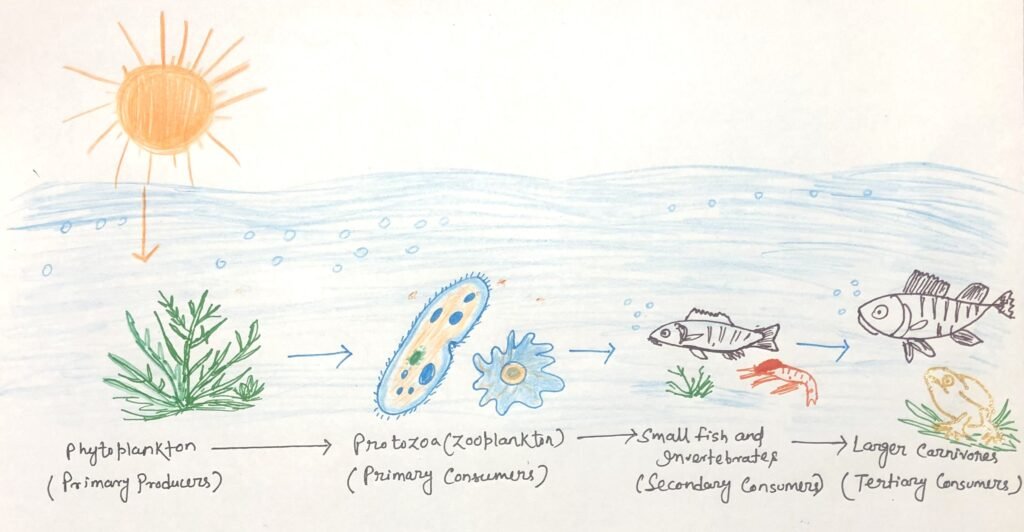
Protozoa occupy a vital position in aquatic food webs, acting as intermediaries in the transfer of energy through ecosystems. In marine environments, many protozoa form part of the zooplankton community, where they consume photosynthetic phytoplankton. These phytoplankton function as primary producers, converting light energy into chemical energy through photosynthesis. The protozoan zooplankton, as primary consumers, are then preyed upon by larger carnivorous organisms, which serve as secondary consumers (Figure 1). Thus, energy flows sequentially from sunlight to phytoplankton, to zooplankton, and ultimately to higher-level carnivores.
Beyond their role in grazing food chains, protozoa also contribute significantly to ecological balance through their involvement in decomposition processes. Saprophytic and bacteria-feeding protozoa utilize organic materials generated during the breakdown of dead plants and animals, as well as waste products such as feces. In this detritus-based pathway, organic remains are first decomposed by fungi and bacteria, after which protozoa ingest the bacteria, thereby recycling nutrients back into the ecosystem.
Protozoa also play an increasingly recognized role in sewage treatment and waste management. While bacteria are central to the degradation of organic pollutants, protozoa enhance the efficiency and stability of the process. Biological sewage treatment typically includes anaerobic digestion and aerobic stages. During anaerobic digestion, protozoa such as Metopus, Saprodinium, and Epalxis are active participants. In aerated treatment systems that involve oxygenation and flocculation, aerobic protozoa, including Bodo, Paramecium, Aspidisca, and Vorticella, contribute to the purification process by consuming bacteria and clarifying the effluent.
Through these interconnected roles in food webs, nutrient recycling, and waste treatment, protozoa significantly support the functioning and sustainability of aquatic ecosystems.
Protozoa in Waste Management and Human Health
In industrial effluent treatment systems, operators expose settling tanks to light, especially when excessive nitrates and phosphates accumulate, to promote the growth of algae and protozoa. These microorganisms assimilate inorganic nutrients from the water to support their own metabolic activities, thereby reducing nutrient loads and improving overall water quality. Treatment systems remove the resulting biomass, which consists mainly of autotrophic organisms, from the surface, dry it, and repurpose it as fertilizer. Despite their beneficial ecological roles, certain protozoa are pathogenic and responsible for significant diseases in animals and humans. These parasitic forms multiply within their hosts like bacteria, often surviving exclusively as obligate parasites. Their infections may be acute or chronic, leading to considerable health burdens. Notable protozoan diseases affecting humans include intestinal amoebiasis, African sleeping sickness, and malaria.
Conclusion
Protozoa occupy a central position in natural ecosystems and demonstrate remarkable adaptability to diverse environmental conditions. Their distribution is governed by physical, chemical, and biological factors, while their interactions with other organisms range from beneficial symbiosis to harmful parasitism. As primary consumers in aquatic food webs, regulators of bacterial populations, participants in nutrient cycling, and contributors to waste treatment processes, protozoa play indispensable roles in maintaining ecological balance. Although some species are pathogenic and responsible for serious diseases, their overall significance in sustaining environmental stability and supporting life processes far outweighs their harmful effects. Thus, protozoa represent not only fundamental components of nature but also key indicators of ecosystem health and environmental change.
You may also like:

I, Swagatika Sahu (author of this website), have done my master’s in Biotechnology. I have around fourteen years of experience in writing and believe that writing is a great way to share knowledge. I hope the articles on the website will help users in enhancing their intellect in Biotechnology.