
This article describes the fundamental differences between the immune responses mounted against extracellular and intracellular bacterial pathogens. The immune system employs distinct defense strategies depending on the location and lifestyle of the invading bacteria, ensuring their effective recognition, containment, and elimination. While extracellular bacteria are primarily targeted by antibody-mediated mechanisms, intracellular bacteria require robust cell-mediated immune responses for their control. Understanding these specialized immune pathways is essential for appreciating host defense against bacterial infections and the pathogenesis of immune-mediated diseases.
Immune Recognition and Defense Against Bacterial Pathogens
Bacteria gain access to the human body through multiple portals. These include the respiratory, gastrointestinal, and urogenital tracts, or by breaching protective barriers such as the skin and mucosal surfaces following injury or trauma. Once inside the host, their ability to establish an infection depends on several factors. These factors include the infectious dose, the virulence of the invading organism, and the effectiveness of the host’s immune defenses. In many instances, bacteria that enter in small numbers or possess limited virulence are rapidly eliminated by innate immune mechanisms, with resident macrophages, neutrophils, antimicrobial peptides, and the complement system providing an immediate, non-specific line of defense.
However, highly virulent pathogens, larger bacterial inocula, or microorganisms capable of surviving within host cells frequently evade these early defenses, necessitating the activation of antigen-specific adaptive immunity. The location in which bacteria reside during infection profoundly influences the nature of the immune response. Extracellular bacteria proliferate in tissues, blood, or other body fluids where they are readily accessible to antibodies, complement proteins, and professional phagocytes. In contrast, intracellular bacteria establish themselves within host cells, shielding themselves from many humoral immune mechanisms and requiring robust cell-mediated immune responses for their elimination. Consequently, the immune system employs distinct yet coordinated defensive strategies to combat these two categories of bacterial pathogens. This is achieved by utilizing various immune cells, cytokines, and effector mechanisms tailored to the pathogen’s lifestyle.
Immune-Mediated Pathology
Although these immune responses are indispensable for controlling bacterial infections, they can also contribute significantly to disease pathology. In certain infections, the clinical manifestations arise less from direct bacterial damage than from an exaggerated or dysregulated host immune response. Excessive production of pro-inflammatory cytokines and widespread activation of immune pathways can result in severe systemic inflammatory conditions such as septic shock, toxic shock syndrome, and some forms of food poisoning.
Therefore, an effective antibacterial response requires not only efficient pathogen elimination but also precise regulation to minimize collateral tissue damage. Understanding how the immune system differentially recognizes and responds to extracellular and intracellular bacteria is fundamental to appreciating both host protection and the pathogenesis of bacterial diseases.
Immune Responses to Extracellular Bacteria
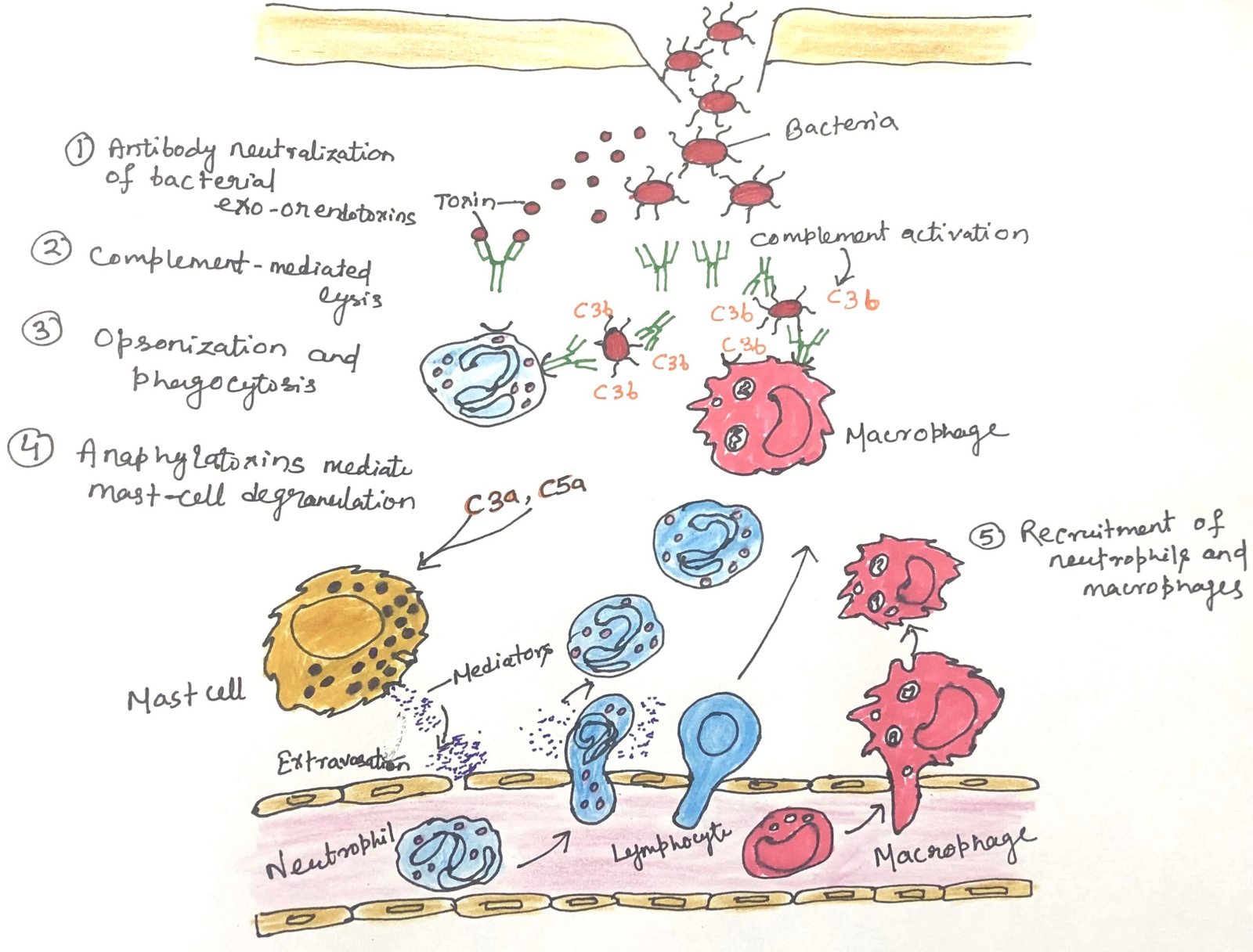
Protection against bacterial infections is achieved through the coordinated actions of both humoral and cell-mediated immunity, with the relative contribution of each arm depending largely on whether the pathogen resides outside or within host cells. Because extracellular bacteria remain exposed in body fluids and tissues, they are readily accessible to circulating antibodies and complement proteins. Consequently, humoral immunity serves as the principal adaptive defense against these pathogens. Following infection, antigen-specific B lymphocytes differentiate into antibody-secreting plasma cells, primarily within regional lymph nodes and the mucosal lymphoid tissues of the respiratory and gastrointestinal tracts. The antibodies they produce neutralize bacterial toxins, promote opsonization to enhance phagocytosis, activate the classical complement pathway, and ultimately facilitate the efficient elimination of invading microorganisms.
In addition to eliciting antibody-mediated immunity, extracellular bacteria frequently provoke a robust inflammatory response at the site of infection. This inflammation may be initiated by structural components of the bacterial cell or by potent bacterial toxins. Endotoxins, such as lipopolysaccharide (LPS), present in the outer membrane of Gram-negative bacteria, strongly stimulate innate immune cells to release pro-inflammatory cytokines. In contrast, exotoxins are soluble proteins actively secreted by certain bacterial species, often exerting highly specific toxic effects on host tissues. Classic examples include the neurotoxin produced by Clostridium tetani, the causative agent of tetanus, and the diphtheria toxin synthesized by Corynebacterium diphtheriae, both of which contribute significantly to disease pathogenesis. Thus, effective immunity against extracellular bacteria relies not only on the rapid production of protective antibodies but also on the controlled regulation of inflammatory responses to prevent excessive tissue damage.
Antibody-Mediated Effector Mechanisms Against Extracellular Bacteria
Antibodies represent the primary adaptive defense against extracellular bacteria by employing multiple effector mechanisms that facilitate the elimination of pathogens. Upon binding to bacterial surface antigens, antibodies coat the microorganism and function as opsonins, markedly enhancing its recognition and ingestion by professional phagocytes such as neutrophils and macrophages. This process is further strengthened by the deposition of complement component C3b on the bacterial surface, which acts synergistically with antibodies to promote efficient phagocytosis and subsequent microbial clearance.
In addition to enhancing opsonization, antigen-bound antibodies activate the classical complement pathway, generating a cascade of complement proteins that amplify host defense. For susceptible bacteria, particularly many Gram-negative species, complement activation culminates in the formation of the membrane attack complex (MAC), which disrupts the bacterial cell membrane and results in direct lysis of the pathogen. Beyond its bactericidal activity, complement activation also produces biologically active fragments that intensify the inflammatory response. The complement-derived peptides C3a and C5a function as potent anaphylatoxins, stimulating mast-cell degranulation and the release of vasoactive mediators (Figure 1). These mediators increase vascular permeability and promote vasodilation. These vascular changes facilitate the rapid migration of leukocytes, including neutrophils and lymphocytes, from the bloodstream into infected tissues.
Complement-Mediated Inflammation and Toxin Neutralization
Complement proteins also play an essential role in directing immune cells to sites of infection. Notably, C5a serves as a powerful chemoattractant, recruiting neutrophils and macrophages to areas of bacterial invasion, where they participate in the engulfment and destruction of pathogens. Through these coordinated actions, the complement system not only enhances antibody-mediated bacterial clearance but also orchestrates the development of an effective inflammatory response.
Another critical function of antibodies is the neutralization of bacterial toxins. By binding specifically to exotoxins, antibodies prevent these toxic molecules from interacting with their cellular targets, thereby blocking their pathogenic effects. Phagocytic cells subsequently recognize and remove the resulting antigen–antibody complexes, ensuring the safe clearance of toxins from the circulation and limiting tissue injury. Collectively, these antibody-dependent mechanisms, including opsonization, complement activation, inflammatory amplification, and toxin neutralization, provide a highly effective defense against extracellular bacterial infections.
Cell-Mediated Immunity Against Intracellular Bacteria
Unlike extracellular pathogens, intracellular bacteria evade many antibody-mediated defense mechanisms by residing within host cells, where they are largely inaccessible to circulating antibodies and complement proteins. Consequently, the immune system relies predominantly on cell-mediated immunity to eliminate intracellular bacteria by recognizing and destroying infected host cells while enhancing the antimicrobial functions of phagocytes.
The immune response begins with the recognition of intracellular bacteria by pattern-recognition receptors, including Toll-like receptors (TLRs), which detect conserved microbial components and initiate innate immune signaling. This early recognition stimulates the production of inflammatory cytokines and activates natural killer (NK) cells, providing an immediate line of defense. NK cells contribute to host protection by destroying infected cells and secreting interferon-gamma (IFN-γ), which enhances the antimicrobial activity of macrophages during the initial stages of infection.
TH1 Cell-Mediated Immunity Against Intracellular Bacteria
Although innate immunity provides early containment, complete eradication of intracellular bacteria requires a robust T helper 1 (TH1)-mediated adaptive immune response. Antigen-presenting cells activate CD4⁺ TH1 lymphocytes, which secrete cytokines that orchestrate cellular immunity. Among these cytokines, IFN-γ plays a pivotal role by activating macrophages, significantly enhancing their ability to phagocytose and eliminate intracellular bacteria through increased production of reactive oxygen species, reactive nitrogen intermediates, and lysosomal enzymes. TH1 cells also mediate delayed-type hypersensitivity (DTH) responses, which recruit and activate additional immune cells at the site of infection, thereby strengthening antimicrobial defense.
TH1-mediated immunity plays an important role in controlling infections caused by Mycobacterium species, especially Mycobacterium tuberculosis. These bacteria have evolved mechanisms to survive and replicate within macrophages, making them highly resistant to antibody-mediated clearance. Effective control of tuberculosis, therefore, relies on the generation of a vigorous TH1 response and sustained macrophage activation, both of which are essential for restricting bacterial replication and promoting pathogen elimination.
Conclusion
The immune system employs distinct yet complementary strategies to eliminate extracellular and intracellular bacterial pathogens. Antibodies primarily control extracellular bacteria through mechanisms such as opsonization, complement activation, and toxin neutralization. In contrast, intracellular bacteria require robust cell-mediated immunity driven by TH1 lymphocytes and activated macrophages. Together, the innate and adaptive immune systems provide effective protection against bacterial infections. Understanding these differential immune responses is essential for advancing vaccine development, immunotherapy, and the treatment of bacterial diseases.
You may also like:

I, Swagatika Sahu (author of this website), have done my master’s in Biotechnology. I have around fourteen years of experience in writing and believe that writing is a great way to share knowledge. I hope the articles on the website will help users in enhancing their intellect in Biotechnology.