
This article describes the molecular mechanisms underlying the proteolytic zymogen cascade that governs blood coagulation. Blood coagulation is an essential physiological process that protects the body from excessive blood loss following vascular injury. This highly regulated mechanism is driven by a cascade of proteolytic reactions in which inactive zymogens are sequentially converted into active enzymes, resulting in the formation of a stable fibrin clot. The coagulation cascade represents a remarkable example of biological signal amplification and precise regulatory control. This article provides an overview of the molecular mechanisms underlying clot initiation, propagation, regulation, and the clinical implications associated with defects or therapeutic modulation of the coagulation system.
Molecular Basis of Blood Coagulation
Blood coagulation is a vital physiological process that prevents excessive blood loss following vascular injury. The formation of a blood clot involves the accumulation of platelets and the development of a stable fibrin network that reinforces the clot structure. Fibrin is generated from fibrinogen, a soluble plasma protein that circulates abundantly in the bloodstream under normal conditions. The conversion of fibrinogen into fibrin is driven by a highly coordinated sequence of enzymatic reactions known as the coagulation cascade.
This cascade represents one of the most remarkable examples of biological signal amplification. It operates through the sequential activation of inactive protein precursors, or zymogens, which are converted into active enzymes by specific proteolytic cleavage events. As each activated factor triggers the activation of downstream factors, the response is rapidly amplified, ensuring efficient clot formation at the site of injury. In addition to providing rapid hemostatic protection, the coagulation cascade integrates multiple regulatory mechanisms that maintain a delicate balance between clot formation and excessive thrombosis. Consequently, the proteolytic activation of zymogens forms the molecular foundation of blood coagulation and plays a crucial role in preserving vascular integrity.
Regulatory Cascades and Signal Amplification
Regulatory cascades are essential biological mechanisms in which an initial molecular stimulus triggers a sequential series of protein activation events. In this process, one activated protein stimulates the activation of subsequent proteins, creating a chain reaction that significantly amplifies the original signal. Because each activated protein can act as a catalyst for multiple downstream targets, even a small initial stimulus can generate a rapid and substantial biological response.
The activation mechanisms involved in these cascades may differ depending on the physiological context. Some pathways rely on proteolytic cleavage, where inactive precursor proteins are converted into their active forms through irreversible cleavage events. Other cascades involve reversible chemical modifications, such as phosphorylation, allowing precise and dynamic control of protein activity. Regulatory cascades are fundamental to numerous biological functions, including blood coagulation, cellular differentiation during development, visual signal transduction in retinal photoreceptor cells, and programmed cell death.
Conversion of Fibrinogen into a Stabilized Fibrin Clot
The terminal stage of the blood coagulation cascade involves the transformation of soluble fibrinogen into an insoluble fibrin network that forms the structural framework of a blood clot. Fibrinogen is a complex plasma glycoprotein composed of two identical sets of three homologous polypeptide chains, namely Aα, Bβ, and γ chains, arranged as a hexameric structure. Activation of fibrinogen occurs through the action of thrombin, a serine protease that selectively cleaves short peptide segments known as fibrinopeptide A and fibrinopeptide B from the amino-terminal regions of the Aα and Bβ chains, respectively.
The removal of these inhibitory peptides exposes new binding regions that promote intermolecular interactions between neighboring fibrin molecules. These interactions drive the spontaneous assembly of fibrin monomers into an extensive polymeric network, resulting in the formation of an initial soft clot. The clot subsequently undergoes stabilization through the activity of activated factor XIII (factor XIIIa), a transglutaminase enzyme that catalyzes covalent bond formation between specific lysine and glutamine residues of adjacent fibrin molecules. This cross-linking process strengthens the fibrin meshwork and converts the fragile soft clot into a mechanically stable and resilient hard clot.
Intrinsic and Extrinsic Pathways of the Coagulation Cascade
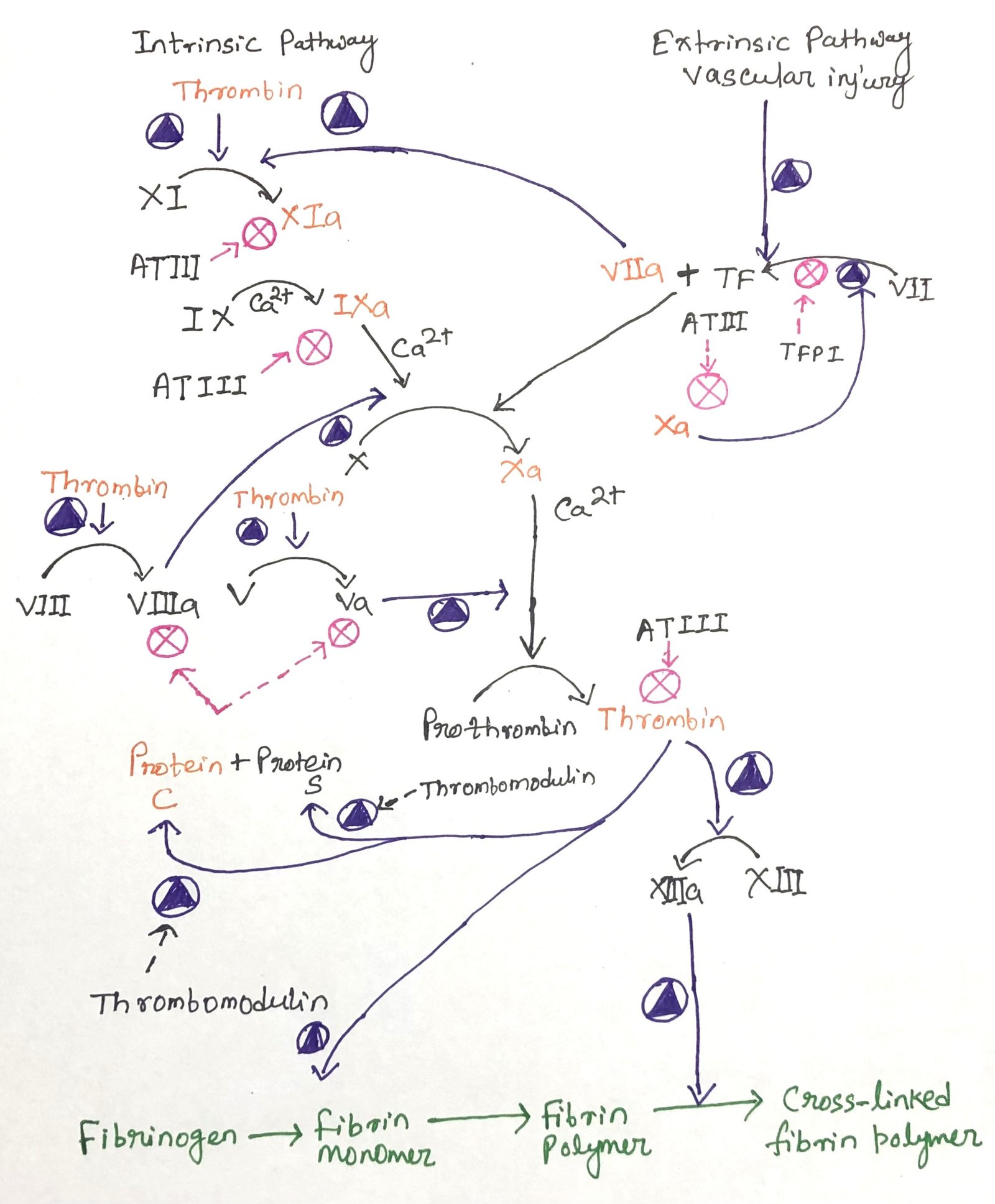
The conversion of fibrinogen into fibrin represents the culmination of two interconnected proteolytic pathways that collectively regulate blood coagulation (Figure 1). One pathway, known as the intrinsic or contact activation pathway, is initiated entirely by components that circulate within the blood plasma. In contrast, the extrinsic pathway is triggered by tissue factor (TF), a membrane-associated protein that is normally absent from the bloodstream but becomes exposed following vascular injury.
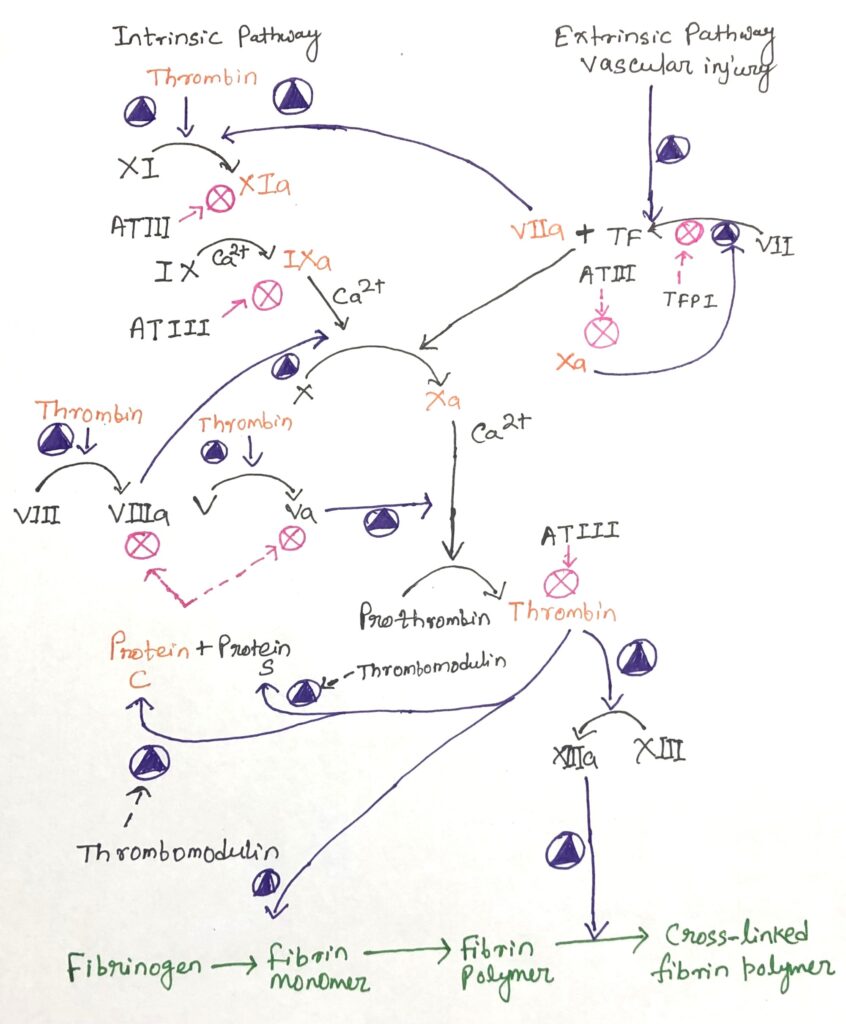
The proteins involved in coagulation pathways are traditionally labeled using Roman numerals. They include several specialized factors with distinct biochemical roles. Many of these factors are chymotrypsin-like serine proteases. They are synthesized in the liver as inactive zymogens. These zymogens are released into the bloodstream. Their activation occurs through sequential proteolytic cleavage. This creates an amplifying enzymatic cascade. In addition to these proteases, the system also includes non-enzymatic regulatory proteins. These proteins interact with clotting enzymes. They support activation, assembly, and precise regulation of the clotting process.
Platelet Activation and Initial Clot Formation
The initiation of blood clotting begins immediately after vascular injury. It involves activation of platelets. Platelets are small anucleate cell fragments circulating in the bloodstream. Damage to a blood vessel exposes underlying extracellular matrix components, particularly collagen fibers, to the flowing blood. Contact between platelets and exposed collagen triggers a series of activation events within the platelets.
Upon activation, platelets undergo membrane remodeling. This leads to the externalization of negatively charged phospholipids. They also release chemical mediators such as thromboxanes. These mediators recruit and activate additional platelets. This creates a positive feedback loop that strengthens platelet activation. It promotes adhesion and aggregation at the injury site. This results in a temporary and unstable platelet plug. However, a stable clot requires a fibrin mesh. This fibrin is produced through sequential proteolytic reactions of the coagulation cascade.
Initiation of the Extrinsic Coagulation Pathway
The extrinsic pathway is the earliest enzymatic response following vascular injury. Damage to the blood vessel wall exposes tissue factor (TF). TF is a membrane-bound regulatory protein found mainly on fibroblasts and smooth muscle cells beneath the endothelium. This exposure allows TF to interact with plasma factor VII. Factor VII is an inactive zymogen of a serine protease. This interaction forms the initial TF–factor VII complex.
Activation of factor VII occurs through specific proteolytic cleavage, resulting in the formation of the active enzyme factor VIIa. The TF–VIIa complex then functions as a catalytic unit that activates factor X by cleaving its zymogen precursor. Thus, it generates factor Xa. The production of factor Xa marks a crucial step in the coagulation cascade. It links the initiation phase of the extrinsic pathway to downstream reactions leading to thrombin generation and fibrin clot formation.
A low basal concentration of activated factor VIIa continuously circulates in the bloodstream. It enables rapid assembly of the TF–VIIa complex after tissue injury. Although initially present in limited amounts, this complex generates factor Xa. This is sufficient to trigger the early amplification phase of the coagulation cascade. As factor Xa accumulates, it proteolytically converts prothrombin, an inactive zymogen, into the active enzyme thrombin. Thrombin subsequently catalyzes the transformation of soluble fibrinogen into insoluble fibrin, thereby promoting the formation and stabilization of the developing blood clot.
Amplification of Coagulation via the Intrinsic Pathway and Feedback Loops
Although the extrinsic pathway rapidly generates an initial surge of thrombin, its activity is transient. It is inhibited by tissue factor pathway inhibitor (TFPI). TFPI suppresses the TF–VIIa complex. To maintain continuous thrombin production, the intrinsic pathway becomes progressively activated. It ensures stable clot development. It then assumes a dominant role in the amplification phase of coagulation.
During the early stages of coagulation, the TF–VIIa complex catalyzes the proteolytic activation of factor IX. Thus, it produces the active serine protease factor IXa. In association with its cofactor factor VIIIa, factor IXa forms a highly efficient enzymatic complex. This complex continues the activation of factor X into factor Xa, thereby sustaining the generation of thrombin. In addition to this route, factor IXa can also arise through activation by factor XIa. The majority of factor XIa is produced when thrombin cleaves the inactive factor XI precursor. This establishes a positive feedback mechanism that further amplifies the coagulation cascade.
Regulation and Termination of the Coagulation Cascade
The coagulation cascade is tightly regulated to prevent excessive clot formation that could obstruct blood vessels and lead to severe thrombotic disorders. As clot development progresses, several inhibitory mechanisms are activated to restrict further amplification of the coagulation response.
Apart from its central role in fibrin generation, thrombin binds to thrombomodulin, a membrane protein expressed on endothelial cells. This complex activates the zymogen protein C, which, together with its cofactor protein S, proteolytically inactivates the essential regulatory factors Va and VIIIa. Thus, it diminishes further thrombin production and attenuates the coagulation cascade.
An additional level of control is provided by antithrombin III (ATIII), a major serine protease inhibitor. It irreversibly neutralizes key coagulation enzymes, especially thrombin and factor Xa. Together with tissue factor pathway inhibitor (TFPI), it regulates coagulation. These anticoagulant systems maintain a balance between hemostasis and thrombosis. They also help establish a threshold for coagulation activation. Deficiencies in protein C or antithrombin III disrupt this balance and significantly increase susceptibility to pathological clot formation.
Therapeutic Approaches to Anticoagulation
The regulation of blood coagulation has significant clinical importance. This prevents unwanted clot formation during surgical procedures and in individuals susceptible to thrombotic conditions such as heart attacks and strokes. Various anticoagulant strategies target different stages of the coagulation process to maintain proper blood flow.
One important approach involves interfering with vitamin K–dependent clotting factors. These factors include factors VII, IX, X, and prothrombin, whose activity relies on vitamin K–mediated γ-carboxylation that enables proper calcium binding and interaction with platelet membranes. Inhibition of this modification reduces the functional activity of these coagulation factors.
Another widely used anticoagulant strategy involves heparins. These are a class of highly sulfated polysaccharides that enhance the inhibitory action of antithrombin III against key coagulation enzymes, particularly thrombin and factor Xa. Thus, it suppresses the progression of the coagulation cascade. Additionally, aspirin exerts antithrombotic effects by inhibiting cyclooxygenase-mediated thromboxane synthesis. The resulting reduction in thromboxane levels decreases platelet activation and aggregation, lowering the likelihood of clot formation.
Genetic Disorders of Blood Coagulation
Inherited abnormalities affecting components of the coagulation cascade can impair the body’s ability to form stable blood clots. This results in an increased tendency to bleed. The severity of these bleeding disorders ranges from mild symptoms to severe, potentially life-threatening hemorrhage. Such genetic defects affecting clotting factor genes are collectively known as hemophilia.
The most common form, hemophilia A, is an X-linked inherited disorder caused by a deficiency or dysfunction of factor VIII. This occurs in approximately one out of every 5,000 male births worldwide. Another major form, hemophilia B, also follows an X-linked pattern of inheritance and arises from a deficiency of factor IX. Both conditions disrupt the normal progression of the coagulation cascade and compromise effective blood clot formation.
Conclusion
The proteolytic zymogen cascade in blood coagulation is a striking example of biological regulation. It operates through sequential activation of inactive precursor proteins. This leads to a rapid and amplified response to vascular injury. Coagulation factors, platelets, and regulatory systems act in a coordinated manner. Together, they ensure efficient clot formation at damaged sites. At the same time, they prevent excessive or inappropriate thrombosis. When this balance is disturbed, it can lead to serious bleeding disorders or abnormal clot formation. Such outcomes highlight the need for precise control of the coagulation system. A detailed understanding of these molecular events has revealed key principles of enzymatic regulation. It has also formed the basis for modern therapeutic approaches to coagulation-related diseases.
You may also like:

I, Swagatika Sahu (author of this website), have done my master’s in Biotechnology. I have around fourteen years of experience in writing and believe that writing is a great way to share knowledge. I hope the articles on the website will help users in enhancing their intellect in Biotechnology.