
This article describes the endosymbiotic origin of chloroplasts and the evolutionary events that led to their formation. It highlights the evidence linking chloroplasts to ancient photosynthetic bacteria and discusses the evolution of photosynthetic mechanisms in microorganisms. These findings offer valuable insights into the evolution of eukaryotic cells and the emergence of photosynthetic life.
Cellular Evidence for the Endosymbiotic Theory
Chloroplasts in modern plant cells exhibit a remarkable level of structural and functional autonomy, sharing several key characteristics with mitochondria. This similarity strongly supports the idea that both organelles originated through comparable evolutionary mechanisms. A defining feature of chloroplasts is the presence of their own genetic material, along with an internal protein-synthesizing system, which allows them a degree of independence from the host cell nucleus.
In chloroplasts, gene expression is divided between two genetic sources: some proteins are encoded by chloroplast DNA and synthesized within the organelle itself, while others are encoded by nuclear genes, produced in the cytoplasm, and subsequently imported into the chloroplast. This coordinated dual-genome system reflects a highly evolved form of intracellular cooperation.
Chloroplasts also demonstrate self-propagation through division during plant cell growth and reproduction. Before division, their DNA is replicated and evenly distributed to daughter chloroplasts, ensuring genetic continuity. At the biochemical level, the mechanisms responsible for light absorption, electron transport, and ATP synthesis in chloroplasts closely resemble those found in cyanobacteria, indicating a shared evolutionary origin.
These molecular and functional parallels provide strong evidence for the endosymbiotic theory, which proposes that ancestral eukaryotic cells engulfed free-living photosynthetic cyanobacteria. Rather than being digested, these organisms established a stable and mutually beneficial symbiotic relationship with the host cell, ultimately evolving into the chloroplasts that power photosynthesis in modern plants.
Diversity of Photosynthetic Mechanisms in Microorganisms
Photosynthetic microorganisms contribute enormously to global primary productivity, accounting for at least half of all photosynthetic activity on Earth. This diverse group includes algae, photosynthetic eukaryotes, and several types of photosynthetic bacteria. Among them, cyanobacteria are unique because they possess both Photosystem II (PSII) and Photosystem I (PSI) operating in sequence. Their PSII is associated with a water-splitting mechanism similar to that found in higher plants, enabling the release of molecular oxygen during photosynthesis.
In contrast, most other photosynthetic bacteria contain only a single reaction center and cannot oxidize water. Consequently, they neither produce oxygen nor utilize water as an electron donor. Many of these organisms are obligate anaerobes, meaning that oxygen is toxic to them. To sustain photosynthesis, they rely on alternative electron donors instead of water.
Alternative Electron Donors in Photosynthetic Bacteria
Certain groups of photosynthetic bacteria utilize inorganic substances as electron sources. For example, green sulfur bacteria oxidize hydrogen sulfide (H₂S) during carbon fixation:
2H₂S + CO₂ → (CH₂O) + H₂O + 2S (in the presence of light)
Rather than releasing oxygen, these organisms generate elemental sulfur as the oxidation product of hydrogen sulfide. Other photosynthetic bacteria depend on organic compounds as electron donors. Some species can use lactate, converting it into pyruvate while simultaneously reducing carbon dioxide:
2 Lactate + CO₂ → (CH₂O) + H₂O + 2 Pyruvate (in the presence of light)
Despite the diversity in electron donors and metabolic pathways, the core process of photosynthesis remains fundamentally similar across plants and photosynthetic bacteria. This commonality becomes evident when photosynthesis is expressed in its generalized form:
2H₂D + CO₂ → (CH₂O) + H₂O + 2D (in the presence of light)
In this equation, H₂D represents any suitable electron donor, while D denotes its oxidized product. H₂D may be water, hydrogen sulphide, lactate, or some other organic compound, depending on the species. This generalized representation highlights the shared biochemical foundation underlying photosynthesis across a wide range of photosynthetic organisms.
Evolutionary Emergence of Oxygenic Photosynthesis
The ancestors of present-day cyanobacteria are believed to have originated through the integration of genetic elements from two distinct groups of photosynthetic bacteria. One lineage likely possessed a reaction center resembling the modern Photosystem II (PSII) pathway found in purple bacteria, while the other contained a system comparable to the Photosystem I (PSI) pathway characteristic of green sulfur bacteria. This genetic merging may have given rise to an organism capable of utilizing two separate photosynthetic mechanisms.
Initially, these photosystems may have functioned independently, with each being activated under specific environmental conditions. As evolutionary processes progressed, cellular adaptations enabled the coordinated operation of both photosystems within a single organism. This integration significantly improved the efficiency of light energy conversion and marked a major advancement in the evolution of photosynthesis.
A crucial development during this transition was the acquisition of water-oxidizing capability by the PSII-like system. The emergence of this water-splitting mechanism allowed electrons to be extracted from water molecules, leading to the release of molecular oxygen as a by-product. This innovation transformed photosynthesis into an oxygen-producing process and ultimately gave rise to the oxygenic photosynthesis characteristic of modern cyanobacteria and plant chloroplasts.
Conserved Energy-Generating Systems in Cyanobacteria
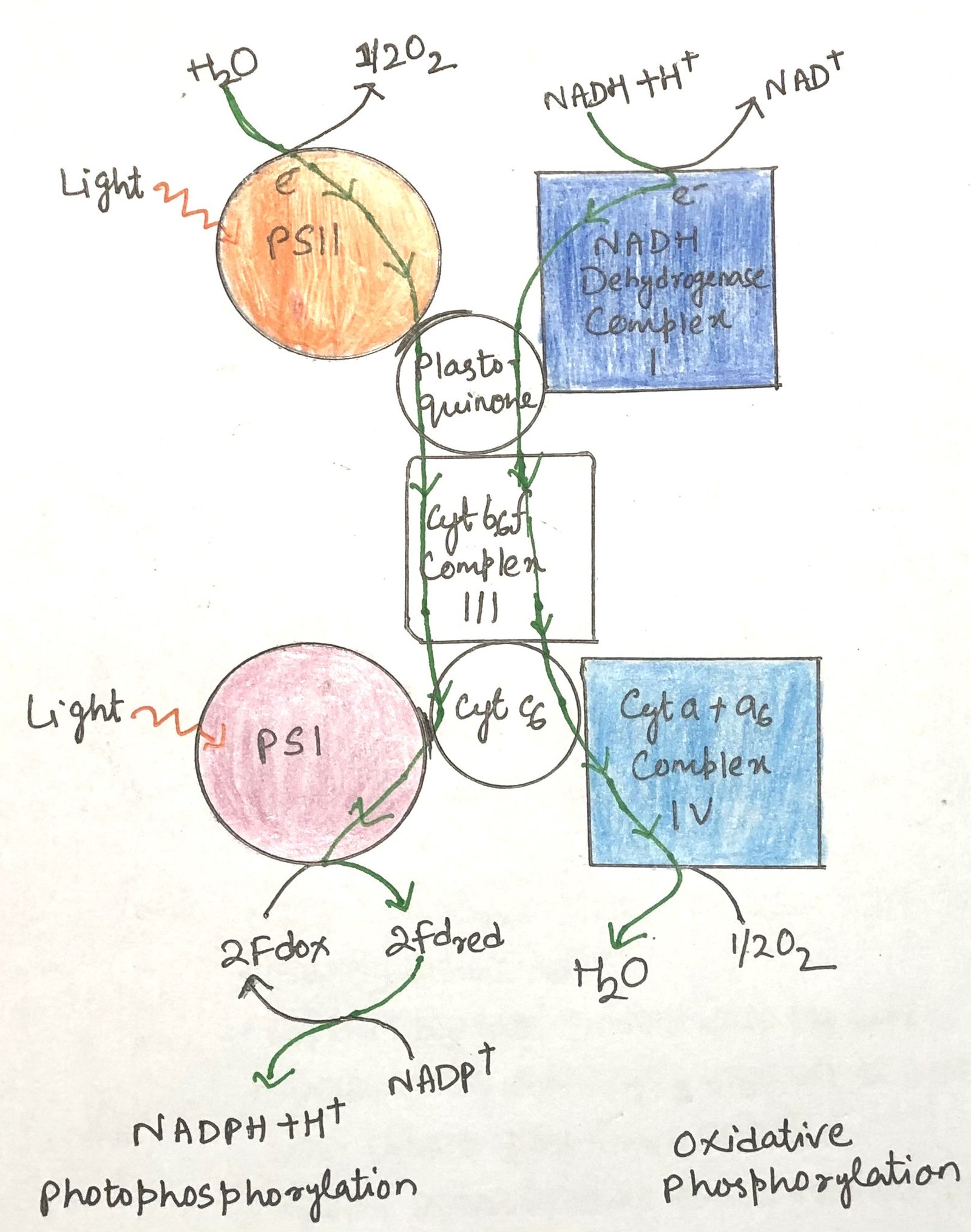
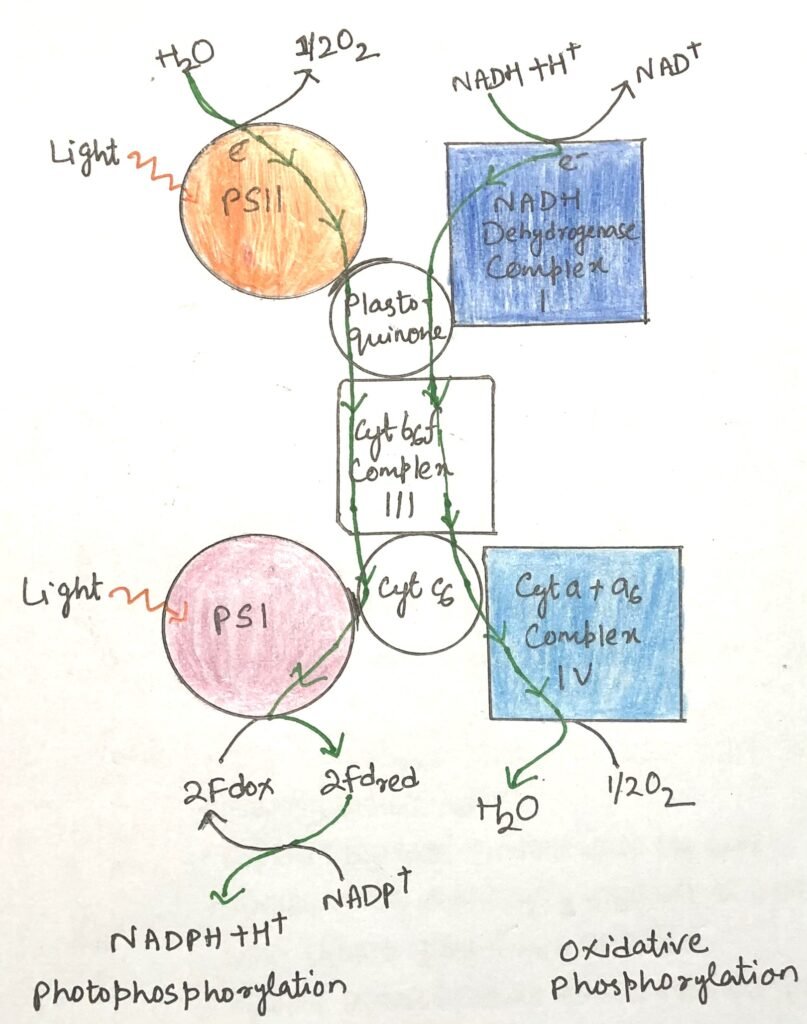
Modern cyanobacteria possess the remarkable ability to generate ATP through both oxidative phosphorylation and photophosphorylation, despite lacking specialized organelles such as mitochondria and chloroplasts. Instead, the molecular machinery required for these energy-converting processes is embedded within an extensively folded plasma membrane. The coexistence of these pathways within a single cellular system provides important insights into the evolutionary relationship between respiration and photosynthesis.
Several key protein complexes participate in both modes of ATP production. It indicates that these metabolic processes likely evolved from a common ancestral bioenergetic framework (Figure 1). One such component is the cytochrome b₆f complex, which serves as an electron-transfer intermediary during photosynthesis by shuttling electrons from plastoquinone to cytochrome c₆. The same complex also contributes to respiratory electron transport by transferring electrons from ubiquinone to cytochrome c₆. It is a function analogous to that performed by the cytochrome bc₁ complex in mitochondria.
Evolutionary Links in Bioenergetic Systems
Cytochrome c₆, a protein closely related to mitochondrial cytochrome c, is a highly conserved element. In cyanobacterial respiration, it transports electrons between respiratory complexes. However, in photosynthesis, it delivers electrons from the cytochrome b₆f complex to Photosystem I (PSI). In higher plants, a comparable role is carried out by plastocyanin. These functional similarities highlight the evolutionary connections among electron transport systems in cyanobacteria, chloroplasts, and mitochondria.
A third universally conserved component is ATP synthase, the enzyme responsible for converting electrochemical energy into ATP. In cyanobacteria, ATP synthase operates during both respiratory and photosynthetic energy conversion, whereas in eukaryotic cells it performs the same function within mitochondria and chloroplasts. The fundamental structure and rotary catalytic mechanism of this enzyme have remained remarkably unchanged throughout evolutionary history, underscoring its central role in cellular energy metabolism.
Collectively, these shared molecular features provide compelling evidence for the common evolutionary origins of photosynthetic and respiratory energy-conserving systems and illustrate how ancient bioenergetic pathways were preserved and adapted across diverse forms of life.
Light-Driven Energy Production in Halophilic Archaea
Some archaea have evolved a unique mechanism for harnessing light energy that differs significantly from photosynthesis. The halophilic archaeon Halobacterium salinarum inhabits extremely saline environments, where oxygen availability can become limited. Under such conditions, sunlight serves as an additional energy source.
Its plasma membrane contains bacteriorhodopsin, a light-sensitive protein that uses retinal as a chromophore. Upon absorbing light, retinal undergoes a structural change that triggers the outward transport of protons across the membrane. This process generates an electrochemical gradient that powers ATP synthesis through ATP synthase.
Unlike cyanobacteria and plants, H. salinarum does not produce oxygen or reduce NADP⁺ during light-driven energy conversion. Instead, it employs a much simpler system in which light directly fuels proton pumping and ATP production. Thus, it demonstrates an alternative evolutionary strategy for capturing solar energy.
Conclusion
The evolution of chloroplasts represents one of the most significant events in the history of life on Earth. Extensive structural, genetic, and biochemical evidence supports the endosymbiotic origin of chloroplasts. These organelles are believed to have evolved from ancient photosynthetic cyanobacteria that established a symbiotic relationship with early eukaryotic cells. Modern chloroplasts share many features with cyanobacteria, including similarities in their genetic systems, photosynthetic machinery, and energy-converting pathways. Together, these similarities provide strong evidence for their common evolutionary ancestry.
You may also like:
- The Purple and Green Phototrophic Bacteria
- Protozoa in Nature and Their Ecological Significance
- Archaebacteria and Their Unique Adaptations

I, Swagatika Sahu (author of this website), have done my master’s in Biotechnology. I have around fourteen years of experience in writing and believe that writing is a great way to share knowledge. I hope the articles on the website will help users in enhancing their intellect in Biotechnology.