
This article briefly describes the immune responses to viral infections, the mechanisms viruses use to evade host defences, and the processes that contribute to viral antigenic variation. Viral infections trigger coordinated immune responses that help the body detect and eliminate invading viruses. The innate immune system provides the initial defence, while adaptive immunity develops a more specific response against viral particles and infected cells. However, viruses have evolved diverse strategies to evade or weaken these host immune defences. Antigenic variation can further help viruses escape existing immune recognition and continue spreading. Influenza viruses provide an important example of this process, with antigenic drift and antigenic shift generating viral variants with altered surface antigens.
Innate Responses to Viral Infection
The innate immune system provides an early line of defence against viral infections and can control or eliminate many viruses before the adaptive immune response becomes fully active. Complement activation, antimicrobial peptides, and pattern-recognition receptors (PRRs) expressed by immune cells contribute to this initial defence. Viral components such as double-stranded RNA (dsRNA) can be detected by specific PRRs located within cells or in endosomal compartments, including members of the NOD-like receptor (NLR) and Toll-like receptor (TLR) families. Recognition of these viral structures activates signalling pathways that promote the production of type I interferons, particularly IFN-α and IFN-β, as well as the activation of inflammasome pathways and natural killer (NK) cells.
Type I interferons bind to their receptors on target cells and activate the JAK-STAT signalling pathway, which induces the expression of several antiviral genes. These antiviral proteins can interfere with viral RNA and protein synthesis, thereby limiting viral replication and helping nearby cells develop an antiviral state. Type I interferons also enhance the cytotoxic activity of NK cells, allowing them to eliminate infected cells. Cytokines such as IL-12 further support this response, and dendritic cells can produce them early during viral infection. Together, these innate immune mechanisms not only restrict viral replication but also provide signals that help shape the subsequent adaptive immune response.
Adaptive Immune Responses to Viral Infection
Antibodies contribute significantly to controlling viruses during the early stages of infection by recognizing viral particles and limiting their spread. However, antibodies may be insufficient once a virus establishes itself within host cells, particularly when viral genetic material becomes associated with the host cell genome. At this stage, cell-mediated immunity becomes essential for eliminating infected cells. CD8+ cytotoxic T cells and CD4+ T helper 1 (TH1) cells are important components of this antiviral response. Activated TH1 cells release cytokines such as IL-2, IFN-γ, and TNF-α, which support antiviral defence through different mechanisms. IFN-γ can induce antiviral responses in neighbouring cells, while IL-2 promotes the activation and expansion of cytotoxic T-cell precursors. IL-2 and IFN-γ can also enhance NK-cell activity, helping control infected cells before a strong virus-specific CTL response develops. TH1-mediated signals additionally support antigen-presenting cells in activating naïve CD8+ T cells.
Virus-specific cytotoxic T-lymphocyte (CTL) responses generally become detectable within several days of infection and reach their highest levels during the following week. CTLs recognize and destroy infected host cells, thereby reducing cellular sources of newly produced virus and contributing to clearance of the infection. After the acute response subsides, a population of virus-specific memory CD8+ T cells remains in the body. These memory cells can respond more rapidly if the same virus is encountered again, providing longer-term immune protection. This memory response is highly specific to the viral antigens encountered during the initial infection, although the degree of protection can vary when related viral strains differ antigenically.
Viral Evasion of Innate and Antigen-Specific Immunity
Although viruses have relatively small genomes, many encode proteins that interfere with important host defence mechanisms. Their rapid replication allows them to produce large numbers of viral particles before the immune system can completely control the infection. Since type I interferons are central to antiviral innate immunity, several viruses have evolved mechanisms that weaken interferon-mediated responses. For example, hepatitis C virus can interfere with protein kinase R (PKR), an important component of antiviral signalling, thereby reducing the effectiveness of interferon-induced antiviral activity.
Viruses can also interfere with antigen presentation, which is essential for the activation of virus-specific T cells. Herpes simplex virus produces proteins that inhibit the transporter associated with antigen processing (TAP). This prevents viral peptides from being efficiently transported for loading onto MHC class I molecules and reduces their presentation to CD8+ T cells. As a result, infected cells become less readily recognized by cytotoxic T lymphocytes. Adenoviruses and cytomegaloviruses have developed different mechanisms that reduce the amount of MHC class I molecules displayed on the surface of infected cells, further limiting recognition by CD8+ T cells.
Viral Antigenic Variation and Immunosuppression
Some viruses evade immune recognition by continuously altering the antigens displayed on their surface. This antigenic variation can reduce the effectiveness of pre-existing immune responses and complicate long-term protection. Influenza viruses, for example, undergo sufficient antigenic change that seasonal vaccines are updated regularly to match circulating strains. HIV exhibits particularly extensive genetic variation, which allows it to generate diverse viral variants and evade recognition by previously developed immune responses.
Other viruses weaken host immunity itself as part of their evasion strategy. HIV can infect immune cells such as lymphocytes and macrophages, altering their function or reducing their numbers. Viral infections may also disturb cytokine production or redirect immune responses toward pathways that provide less effective antiviral protection. Epstein–Barr virus provides another example by producing a protein with properties similar to the host cytokine IL-10. This viral protein can suppress cytokine production by TH1 cells and thereby reduce inflammatory antiviral responses. Through such mechanisms, viruses can both avoid immune recognition and weaken the host responses that would otherwise restrict their replication.
Mechanisms Driving Antigenic Variation in Influenza Viruses
Influenza viruses are enveloped viruses that primarily infect the respiratory tract and can infect humans as well as several animal species, including birds, pigs, horses, and seals. Their outer envelope consists of a lipid bilayer derived from the plasma membrane of the infected host cell and contains two major viral glycoproteins, hemagglutinin (HA) and neuraminidase (NA). HA facilitates viral attachment by binding to sialic acid residues present on glycoproteins and glycolipids on the surface of host cells. In contrast, NA is an enzyme that removes sialic acid from viral and host-cell glycoproteins, helping newly formed viral particles detach and exit from infected cells. Thus, HA and NA play essential and complementary roles in viral entry and release. Beneath the envelope lies a matrix protein layer surrounding the nucleocapsid, which contains the influenza genome. The genome consists of eight single-stranded RNA segments, with each segment encoding one or more viral proteins.
Antigenic Drift and antigenic shift in Influenza
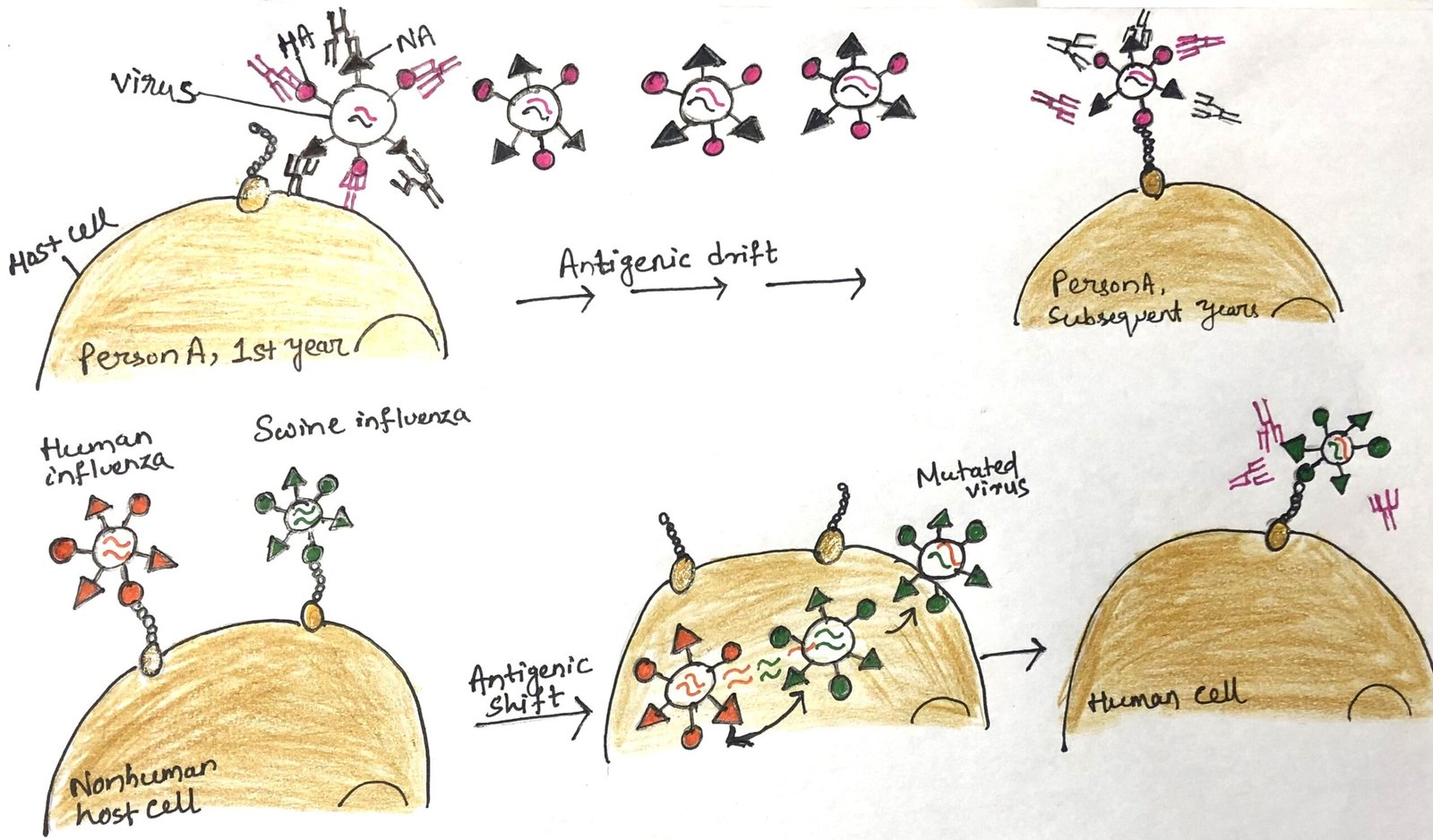
Influenza viruses have multiple antigenic subtypes of hemagglutinin (HA) and neuraminidase (NA). Changes in these surface proteins generate antigenically distinct strains. Two major mechanisms are responsible for this variation, known as antigenic drift and antigenic shift. Antigenic drift results from the gradual accumulation of point mutations in the genes encoding HA and NA, producing relatively small changes in their antigenic properties (Figure 1). The host immune response contributes to the selection of these variants. During a typical influenza season, the circulating virus gradually gives rise to minor antigenic variants. The immune response can eliminate viruses that remain similar to the original strain, whereas variants carrying mutations that reduce recognition by existing antibodies may escape immune clearance. These variants can subsequently spread to other individuals and become predominant, leading to successive cycles of influenza transmission.
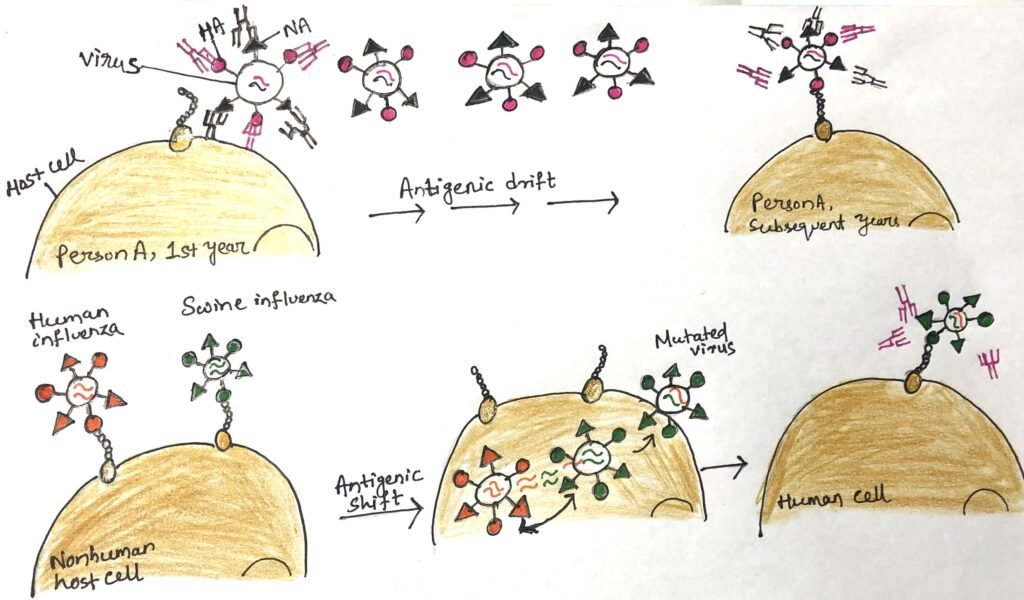
Antigenic shift produces a much more substantial change and can result in the emergence of a new influenza subtype. It primarily occurs through genetic reassortment between influenza viruses originating from humans and other animal hosts (Figure 1). The influenza genome consists of eight separate single-stranded RNA segments, allowing individual segments from different viruses to be exchanged when they infect the same host cell. This reassortment can produce a new combination of viral genes and may generate HA or NA proteins that differ considerably from those of previously circulating strains. Because people may have little or no pre-existing immunity to these novel antigenic combinations, the resulting virus can spread through a population with limited immune recognition.
Conclusion
The immune system provides multiple layers of defence against viral infections, beginning with innate mechanisms and followed by virus-specific adaptive responses. Interferons, natural killer cells, antibodies, and T lymphocytes work together to restrict viral replication and eliminate infected cells. However, viruses have evolved diverse mechanisms to interfere with these defences, including suppression of interferon responses, disruption of antigen presentation, immune modulation, and changes in viral antigens. Influenza viruses illustrate this continual interaction particularly well, as antigenic drift and antigenic shift generate viral variants that can reduce the effectiveness of existing immune recognition. Understanding both antiviral immune responses and viral evasion mechanisms is therefore important for explaining how viral infections persist, spread, and evolve.
You may also like:
- Diseases Related to Complement Deficiencies and Microbes Evolving Strategies to Evade Complement Attack
- Defects in Innate Immune Components Result in Deficiency and Diseases
- Improvement in Vaccine Immunogenicity and Enhancing Immune Response

I, Swagatika Sahu (author of this website), have done my master’s in Biotechnology. I have around fourteen years of experience in writing and believe that writing is a great way to share knowledge. I hope the articles on the website will help users in enhancing their intellect in Biotechnology.